

History of ShereThis page will be updated frequently with new additions - if you would like to add, change or contribute to this or any other page, please contact me - I would love to hear from you. |
||||||||||||||||||||
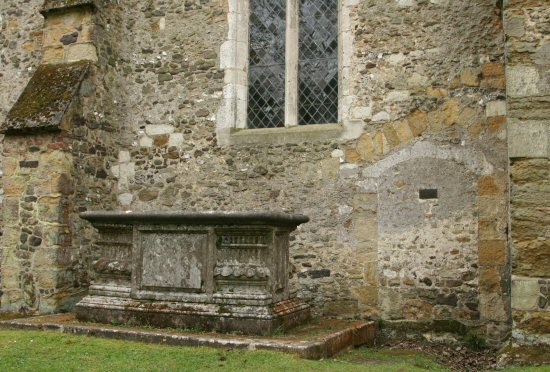
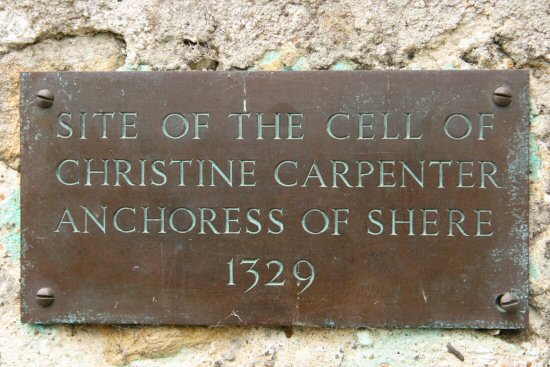
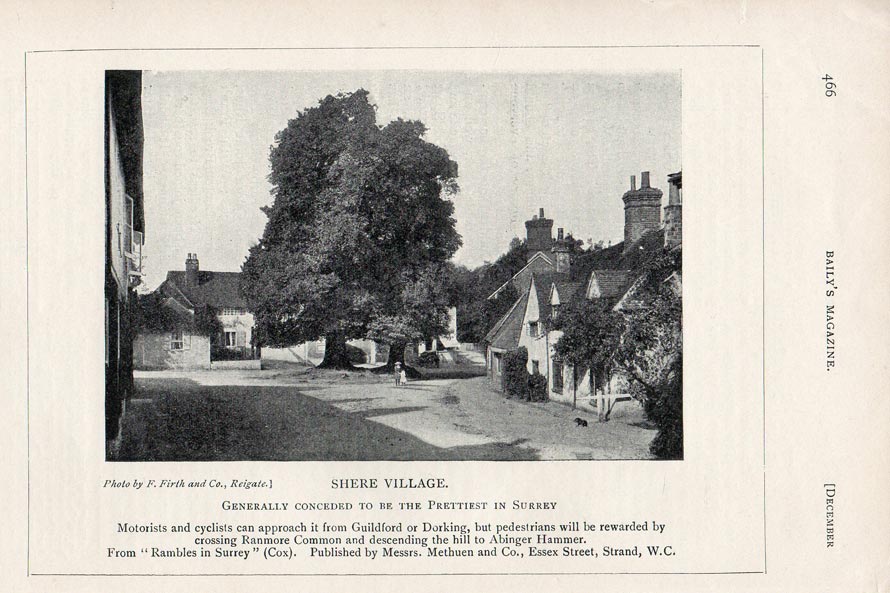
Sheep StealingSheep stealing was rife in the Shere district during the years 1830 to 1840. The parish constables were unable to cope and horses and sheep that disappeared in the south of the county of which most found their way to London. One of the gang's meeting places was The White Horse Inn, Shere and it was not uncommon to see a great deal of poached game on the premises as the men enjoyed themselves. They appeared immune from punishment but then two of the gang took to housebreaking at a large house at Wonersh. MORE The cottages in Shere present a mixture of styles from the 15th to 20th centuries, but the central part of the village is still fundamentally 16th and 17th century, with many timber-framed houses. The names of the cottages in Lower Street, indicate the growth of population and increased prosperity during this period, produced by the woollen industry. Lower Street runs alongside the River Tillingbourne to the Ford. Here you can see The Old Forge, The Old Prison, Weavers House and Wheelright Cottage. Middle Street contains a working forge and village shops and leads to the bridge across the River Tillingbourne, where the wooden Old Fire Station, dated 1885, can be seen. This was the Shere and Albury Volunteer Fire Brigade Station. In 1977, it was converted to public toilets. The White Horse Inn, opposite Church Square, is an attractive black and white timbered building, which in 1450, was a house called, "Cripps". About 1600, a chimney with stone back-to-back fireplaces, was added. It became an inn in the late 17th century. From 1866 – 1945, it was managed by the Askew family and the inn became frequented by literary and artistic figures. The William Bray, was once known as the Prince of Wales and formerly Cook's Beer House. It was built in the late 18th century, the frontage being an early 20th century addition. The Church of St. James has been a place of worship since 1190. The spire, built between 1213 and 1300, is an excellent example of a brooch spire. It was covered with cedar shingles, but in 2000, these had to be replaced and handmade oak shakes were used. There are several brass plaques in the chancel dating from 1412, excellent for those who seek to take brass rubbings. The Battle of Shere An intriguing aspect of St. James' Church, is The Anchoress of Shere. Christine Carpenter, in 1329 made a solemn promise to devote her life to God and live in a holy place. On 14th August 1329, the Bishop of Winchester gave permission for her to be enclosed in a cell which was built in the North wall of the chancel. Food and drink was given to her through a grating on the outside wall. On the inside of the church can be seen the Quatrefoil through which she received the bread and wine of communion. Through the squint window, she could see the altar. Not surprisingly, after three years, she decided to leave her cell, but for reasons unknown, it is recorded that on 10th November 1332, the Bishop of Winchester agreed to her request to be returned to the cell so "she may be enabled to achieve her salvation". William Carpenter, her father, it is believed, lived where the Willow and Ash Cottages now stand in Lower Street. These were built about 1475. The Lych Gate was designed in 1902 by the architect, Edwin Lutyens, who later became Sir Edwin Lutyens and designed the Cenotaph in Whitehall, London. He designed various buildings in Shere for the Bray family, who have been Lords of the Manor of Shere since 1487. These include The Manor House Lodge and Western Cottages in Upper Street and the building in Middle Street, now used as the Tea Room, "The Lucky Duck", which was formerly known as Asters Tea Shop. Extracts taken from the 'Home' page "Shere is..." |
||||||||||||||||||||
River TillingbourneThe River Tillingbourne (also known as the Tilling Bourne) runs along the south side of the North Downs and joins the River Wey at Guildford. Its source is near Tilling Springs to the north of Leith Hill at grid reference TQ143437 and it runs through Friday Street, Abinger Hammer, Gomshall, Shere, Albury, Chilworth and Shalford. The source is a semi-natural uninhabited area. The catchment is situated on sandstone which has a low rate of weathering. The Tillingbourne is 18 km (11 mi) in length. The Tillingbourne initially flows northward for 4 km (2.5 mi) down the northern slopes of Leith Hill over a series of weirs and cascades, before turning west to run for 14 km (8.7 mi) through Abinger Hammer and Chilworth towards the River Wey at Shalford. The river is classified as a subsequent stream, since its course is determined by the direction of the stratum of softer rock for the majority of its length. The river has four principal tributaries: the Friday Street stream joins at Wootton House; the Holmbury St Mary stream joins at Abinger Hammer; the Sherbourne Brook drains the Silent Pool and Sherbourne Pond and the Law Brook joins near Postford. The river used to power a number of gunpowder, paper and flour mills in the area. The gunpowder mill was at Chilworth. Present day users include a trout farm, watercress beds,a business growing reeds and is often studied by students from nearby field studies centres, such as Sayers Croft. The River Tillingbourne supports a healthy fish population of both wild brown trout and coarse fish. The Environment Agency has been working with local fishermen to improve the habitat for these fish by recreating a pool and riffle habitat and by cutting back overhanging vegetation. |
||||||||||||||||||||
1258 - The Battle of ShereIn 1258 the Bishop of Winchester, Aymer de Valence, ordered 50 of his men to take valuables from Shere church and carry them to France. A band of local men tried to stop the theft, ands one of them was killed at the 'Battle of Shere'. The inhabitants sued the Bishop, but De Valence was able to gain a pardon for all his men. READ MORE HERE |
||||||||||||||||||||
1329 - Anchoress of ShereOn the north side of St' James' Church is where Christine carpenter was immured for several years in the 14th Century.
On the north side of Shere's church is where Christine carpenter was immured for several years in the 14th Century.
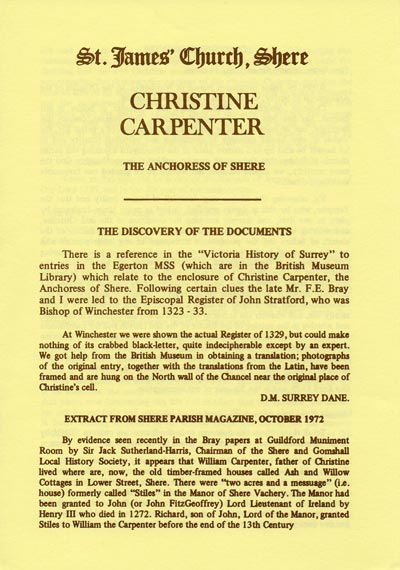
Four page leaflet: Christine Carpenter, Anchoress of Shere - Available from St James church St James' Church, Shere, was built in 1190 (but its lychgate was designed by the architect Edwin Lutyens). It is a rare example of a church in the Early English Transitional Style (with the round Norman arches giving way to pointed ones). The nave pews have numbers - at one time people paid rent to the church for them. The Alms Chest in the church dates from about 1200 and was used to collect money for the crusades fought in the Holy Land. |
||||||||||||||||||||
1671 - Shere Cricket Club |
||||||||||||||||||||
1777 - The WorkhouseA parliamentary report of 1777 recorded three parish workhouses in operation in Guildford — Holy Trinity (for up to 20 inmates), St Mary (24), and St Nicholas (20). There were also parish workhouses in Albury (18), West Clandon (4), Godalming (76), Pirbright [Purbright] (30), Send and Ripley (4), Shiere [Shere] (40), Wisley (8), and Wokeing [Woking] (40). Shere had a "parish house" — a 17th century cottage known as "Allens" — which was in trust for the use of the poor between 1697 and 1802. In 1784, the running of the Shere workhouse was contracted out under a system known as "farming the poor". Thomas Hornsby was paid around 2s.6d. per week for maintaining each of the inmates who numbered between twelve and twenty. The experiment appears not to have been successful as the following years, Mrs Pellate resumed as governor. However, a new contractor, James Gadd, was employed from 1786 to 1789 and paid 2s.3d. per head per week. The farming system continued, with a succession on contractors being employed. In the early 1800s, the numbers in the house rose steadily and reached a very overcrowded peak of 44 in 1819. Conditions in the Shere workhouse were generally comfortable. An 1836 inventory includes "stump" bedsteads (i.e. no headboards), feather beds, flock mattresses, sheets, rugs, bolsters, oak chests, "earthen chambers". A large 15 foot dining-table was used for communal meals which were eaten off wooden trenchers with spoons. The workhouse also had its own bakehouse and brewhouse. OTHER REFERENCE: Book by: Noyes, Anne (1996) Shere Poverty (Twiga Books) |
||||||||||||||||||||
1830 - Policing the Victorian CountrysideThe Early Years1830-1840: Sheep stealing was rife in the Shere district during the years 1830 to 1840. The parish constables were unable to cope and horses and sheep that disappeared in the south of the county of which most found their way to London. One of the gang's meeting places was The White Horse Inn, Shere and it was not uncommon to see a great deal of poached game on the premises as the men enjoyed themselves. They appeared immune from punishment but then two of the gang took to housebreaking at a large house at Wonersh. A constable from Godalming believed to be Biddlecombe traced the men concerned to an inn in Sussex. Enlisting the help of local harvesters they came across the suspects and joked with them and somehow Biddlecombe persuaded them to allow him to handcuff them. Once handcuffed the men were arrested for breaking into Squire Spark's place, taken to Guildford where they were convicted. In addition to the Shere mob there were gangs at Elstead and a team known as the Hut Men at Peper Harow which were broken up soon after the Surrey Constabulary was formed. |
||||||||||||||||||||
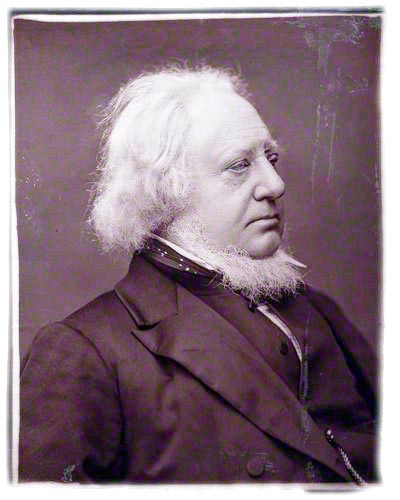
1843 - Sir Henry Cole - The Man who Invented the Christmas Card
Sir HENRY COLE (1808 - 1882) - The man who invented the Christmas card |
||||||||||||||||||||
1851 - William Biddlecombe - Surrey's First Detective
|
||||||||||||||||||||
1856 - Charles Goodwin Norton(1856 - 1940)
British lanternist, filmmaker, projectionist C. Goodwin Norton was born 8 April 1856 in Shere, Guildford, Surrey and in 1899 made a film: Fire Brigade turn-out in the Country (c. 1899) Volunteer firemen at Shere, Surrey, harness a fire engine and ride away. Archive format 35MM Original format 35mm Film Thanks to Don Longhurst for the information - Cheers Don |
||||||||||||||||||||
1875 - The Oldest open air pool in BritainIn 1875 Lady Arthur Russell had a swimming pool built in the middle of Shere so that her six sons could learn to swim. Later she presented it to the village so that the local boys and girls could also learn to swim. Members of the Russell family still live just outside Shere. In 1899 the pool was handed over to the Parish Council which continues to be responsible for it to the present day. It was then used as a public pool, said to be the first public open air pool in Britain. n 1954 it was greatly modernised with filtration and a new surround. It also acquired a lifeguard. It continued to be a popular venue, not only for recreation but also helping hundreds of children and adults to learn to swim. Unfortunately by the late eighties the Parish Council found the pool increasingly difficult to run and finance and a lifeguard proved impossible to find. It looked as if the pool would have to close. The village rallied round and raised a considerable sum of money but not nearly enough to run the pool and employ a lifeguard. In 1989 a local resident, Margaret Ellenger, got together a team of people to save the pool and much hard work was done to replace aged equipment and clean everything up. A lease of the pool was negotiated with the Shere Parish Council. A public pool must have a lifeguard in attendance but this would have be an impossible financial burden so it was decided to operate as a private club. Shere Swimming Pool Club was formed. The Club is non-profit making and charges the lowest practicable subscription so as to remain accessible to all in keeping with Lady Russell's intentions. There is currently a membership in excess of 800 (members and families). The members are welcome to bring guests for a nominal fee. An elected Committee run the Club and all routine maintenance is carried out on a voluntary basis. Shere Swimming Pool Club has proved immensly popular with a large mainly local membership and also some from further afield. The membership is nearly always full with a waiting list and so the pool is enjoyed by very many people throughout the season from May until the end of September. It is a unique and much loved asset to the Parish of Shere. Chris Osborn VIEW Shere Swimming Pool Club website
But one of the oldest in the county has survived and it can be found in the centre of Shere. It was built by Lady Arthur Russell in 1875 so that her six sons could learn. Later she presented it to the village so that the local boys and girls could also learn to swim. In 1899 the pool was handed over to the parish council and for the next 90 years it remained a public pool. Sadly though it became too difficult and costly to run as a public amenity and it only survives today as a private club mostly for local residents.
Searching for Lady Arthur Russell, I discovered this:
Extract taken from the following publication ©Fair Dealing
BUY this book in print. ---
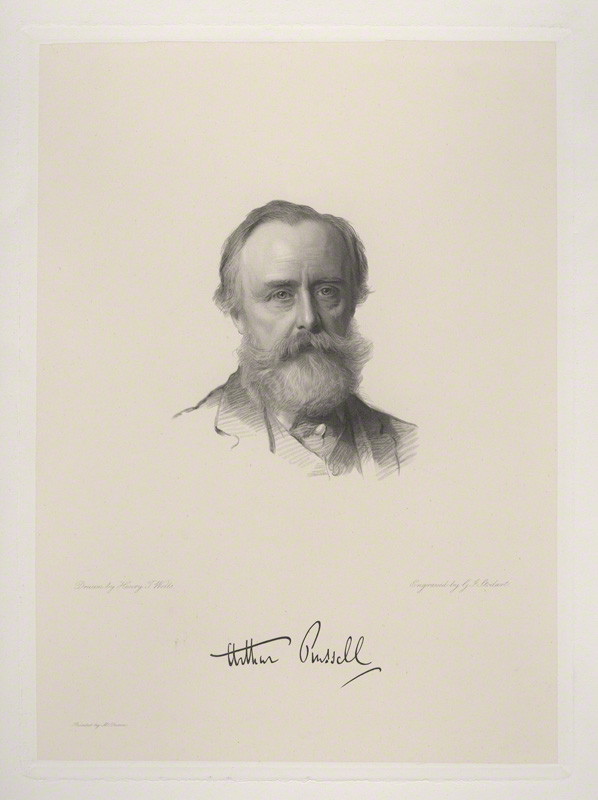
Lord Arthur John Edward Russell (1825-1892)
Drawing: Lord Arthur John Edward Russell DETAILS Wkipedia details for Lord Arthur Russell
Wife: Laura Russell (de Peyronnet), Lady Arthur Russell Mother of To be updated...
Thanks to Diann Arnfield for the following History, right upto the current day (2023) SHERE SWIMMING POOL – BRIEF HISTORY. 1875 - 2023 Lord and Lady Arthur Russell, lived mainly in London but also had a house in Shere, Surrey. Lord Arthur Russell was MP for Tavistock, so therefore, their residence in London was more suitable for his work in Parliament. Shere, may have been their countryside retreat and they lived in Hook Lane, Shere, where today a relative of the Russell family still live – Hugo Russell. (a) In 1875 - Lady Arthur Russell had a swimming pool built, leasing land from the Bray family which is behind the village school & today descendants of the Bray family still live in Shere & are very supportive of the Pool – being an historic part of Shere Village. Lady Russell wanted a pool built in order that her six children could learn to swim- Harold / Flora / Claud / Caroline / Gilbert and Conrad – all of which were born between 1868 – 1878. Later, in 1891, Lady Arthur Russell, presented the pool to the village, so that local children could learn to swim. An important document exists, which is held in Shere Museum, dated 1891, containing 120 signatures of the Inhabitants of Shere and surrounding districts thanking Lady Arthur Russell for her most generous gift. It states the following:-” We the undermentioned in habitants of Shere and the surrounding districts beg to tender our most hearty thanks to The Lady Arthur Russell for her munificent gift of a Swimming Bath to the village of Shere. The way in which it has been already patronized ensures its popularity as an additional source of pleasurable and healthful recreation.” (b) A lease was drawn up – dated 20th June 1892 - between Reginald Moore Bray of one part and Somerset Archibald Beaumont, William Temple Clay and Harold John Hastings Russell of the other part, certain land at Shere aforesaid was demised to the said Somerset Archibald Beaumont, William Temple Clay and Harold J. H. Russell for a term of 200 years. Lease expires in 2092. (c) In 1899 – the pool was handed over to the Shere Parish Council, which continues to be responsible for it to the present day. It was then used as a, Public Pool, said to be the “First Public Open Air Pool in Britain”. The Local Government Board, in a letter to Shere Parish Council dated 20th April 1899, formally approved the adoption of the Baths and Wash – houses Acts by the Parish Meeting, for the Parish of Shere. On the 21st April 1899, Shere Parish Council records, note that a Committee was formed to over see the running of Shere Swimming Baths. Ernest W Bernard, George Fisher & George Sanders served on this committee and dealt with all matters relating to the maintenance of the Pool and employing attendants & reporting back to the Council. The water for the pool was supplied via pipes from Netley Pond & Dr Fisher resolved that one shilling a year be offered to Col Fraser, as nominal consideration for the use by the Parish Council of the water for the Swimming Bath and for laying pipes in the field from Netley Pond. (d) In July 1905, Dr Fisher reported that at that time there was no female attendant. Only few females made use of the bath and when ladies wished to bathe they had the key and went unattended. The Committee did not like to engage a female attendant at the cost of 5 /- a week without getting the opinion of the council. He suggested that the alternative was that the Bath should be closed for Women altogether to prevent any accident!! After some discussion it was resolved that the ladies attendant be engaged for 4 weeks, as from Monday 24th July, at a fee of not exceeding 5/- per week any extension of her services being at the discretion of the Committee of the Bath. During WW1, young men who went to fight in France and Flanders, learnt to swim & dive in the Shere Swimming Bath and for many this helped save their lives. One soldier in particular, George Herbert Grover, learnt to dive and retrieve items from the bottom of the pool, as the water was only changed once a fortnight – hence near its change time, had become very murky & green and one could not see the bottom. Then during the war, George, won medals diving for plate mines in river estuaries, saving many lives. The Grover family, lived in Church Road, The Square, Shere and ran “Grovers” which was a Greengrocers and Fishmongers. (e) December 1938. Sudeten Refugees. Czech Sudeten Refugees, were helped to travel to England by the Social Democratic Party in Czechoslovakia, plus practical help of British Organisations such as the Quakers lead by Tessa Rowntree – British Committee for the Refugees from Czechoslovakia. Three Holiday Hostels accommodated over 100 Czechs in the Surrey Hills, Chilworth, Albury Heath and Farley Green. As a way of quickly acquaint the boys with the English way of life, the Reverend Gray of Albury and a teacher Mr Cobbold suggested they join the Boy Scout movement. So boys from all the Holiday Camps met together and formed a Troop naming themselves the ‘Red Falcons’. The Red Falcons enjoyed many trips out and going to summer camps. September 5th 1940 – was a warm day and ‘Leo Hicke’ one of the Red Falcons which was part of the 9th Guildford Scouts Troop saved the life of a drowning boy at Shere Swimming Pool. Leo was awarded the ‘Gilt Cross’, and Certificate signed by Lord Baden Powell himself. (f) In the early, 1950's the pool was only open during the afternoon, and the entrance fee was one Shilling and a season ticket was seven shillings and sixpence. There were changing rooms at either end, the girls were nearest the stream and the boys nearest the school. There was a springboard at the deep end and beside it a wooden structure making two diving platforms. Mrs Bowler manned the pool, only having one day off a week when the Pool was cleaned out and refilled. Mrs Bowler was in sole charge, which meant that she was the Key-holder, she took the money, she was The First Aider, The Lifeguard, The Cleaner and she taught the children to swim. When it was decided to chlorinate the pool in 1954, Doctor Watson said that if the water was to be chlorinated there must also be a fountain, other wise he would have all the children turning up at the Surgery with eye problems – there fore a fountain was installed. (g) 1954 – Shere Parish Council decided that the pool needed updating, with filtration and new surround. The system they decided on was one of daily re – circulation and chlorination. Parish records show, that of a Meeting held on 18th January 1954 instructs the Council under no circumstances to close the Swimming Bath at Shere and for this purpose, authorises them to raise a Loan, not exceeding £500.00 for the provision of a Chlorinating Plant and Pumping Equipment at the Bath. A letter was duly sent to Surrey County Council, and the Ministry of Housing and Local Government, Whitehall London – requesting a loan of £350 for the purpose of providing a Chlorinating Plant at the Shere Swimming Bath and Pumping Equipment at the Well. The Swimming Bath had been administered by the Parish Council for 67 years in 1954 and the question of the purification of the water had been a matter of concern for some years. The bath was used by 3 schools in the area (twice weekly each school) for swimming instruction and by local organisations such as the Scouts. During the 1953 season - attendances were as follows:- Children 3607 / Adults 325 / Clubs from other areas 105. In addition, 12 Season Tickets were purchased, but apparently 1953 was a short season owing to our inability to obtain fresh water from the Board. Therefore, this is why the Parish Council was requesting the loan, as the Well that is connected to the Bath could be used to augment the present supply of water, if the necessary pumping outfit were installed. (h) Surrey County Council, and the Ministry of Housing and Local Government, agreed to the loan of £350 on 23rd February 1954 in order that the necessary works could be completed. £220 was granted early in 1954 for the Chlorinating Plant to be installed, so that the Bath could be opened in May. The balance of the loan £130, was paid the following year for the Pumping Equipment to be installed at the Well. Furthermore, Shere Parish Council had to comply with the Ministry of Health's publication “The Purification of the Water of Swimming Baths” and to this end sent an analysis of the Well Water. The Medical Officer of Health, Guildford Rural District Council, stated in a letter to the Parish Council of 20th October 1953 – his comments on the water samples taken:- “You will note that the water is considered satisfactory for bathing purposes and with efficient chlorination, it should be quite satisfactory.” In the late 1950's / early 1960's there was an official opening of the pool by Alicia Russell who was Hugo Russell's mother. (i) In 1989 a local resident, Margaret Ellenger, got together a team of people to save the pool, as to continue to run the pool as a public pool was becoming an impossible financial burden for Shere Parish Council. During that summer, several fund raising events were held, the pool was saved and a lease was negotiated and Shere Swimming Pool Club was formed. In 1991 – Shere Swimming Pool. Centenary, 100 years, since bequeathed to Shere and surrounding districts. 1891 – 1991 by Lady Arthur Russell. There was a small celebration and swimming gala held at the Pool, after Alicia Russell dived in to start the proceedings. The Club is non – profit making and charges the lowest practicable subscription, so as to remain accessible to all in keeping with Lady Russell's intention. In 1996, there was a membership in excess of 800 (members and families). Members are welcome to bring guests for a nominal fee. An elected Committee - Shere Swimming Pool Committee run the Club and all routine maintenance is carried out on a voluntary basis. 2020 – 2023. During the past three years, as well as the SSPC having to manage the use of the Pool during the Covid lockdowns 2020 – 2021/22, by introducing lane swimming, plus other safety measures as to number of people using the pool at any one time, there have been major updates to the Pool. These include update of pool equipment / filtration in the pump room and major depth change + complete overhaul of pool interior with tiles. In 2022, we saw the sad demise of the rickety wooden changing rooms and ivy that clung onto their ancient homes, to the bitter end, only to be replaced with modern brick changing rooms. Then in the latter end of 2022 / 23 installation of a new boiler + an Air Source Heat Pump – re energy efficiency. (j) 2023. Schools use the Pool. This season saw the return of the local schools using the Pool again – Shere Church of England Infant School & Clandon Church of England Primary School. These and other schools, organisations used to use the pools 1 / 2 afternoons a week in the 1950’s /60’s. Shere Swimming Pool Club continues to be immensely popular with a large mainly local membership and also some further afield. The membership is nearly always full with a waiting list and so the pool is enjoyed by very many people throughout the season from May until the end of September/ early October. (k) It is unique and much loved asset to the Parish of Shere. (Chris Osborn / October 1996). ****** Diann Arnfield. July 2019. Updated 2023. (Shere Pool Member / Volunteer, since 1989)
|
||||||||||||||||||||
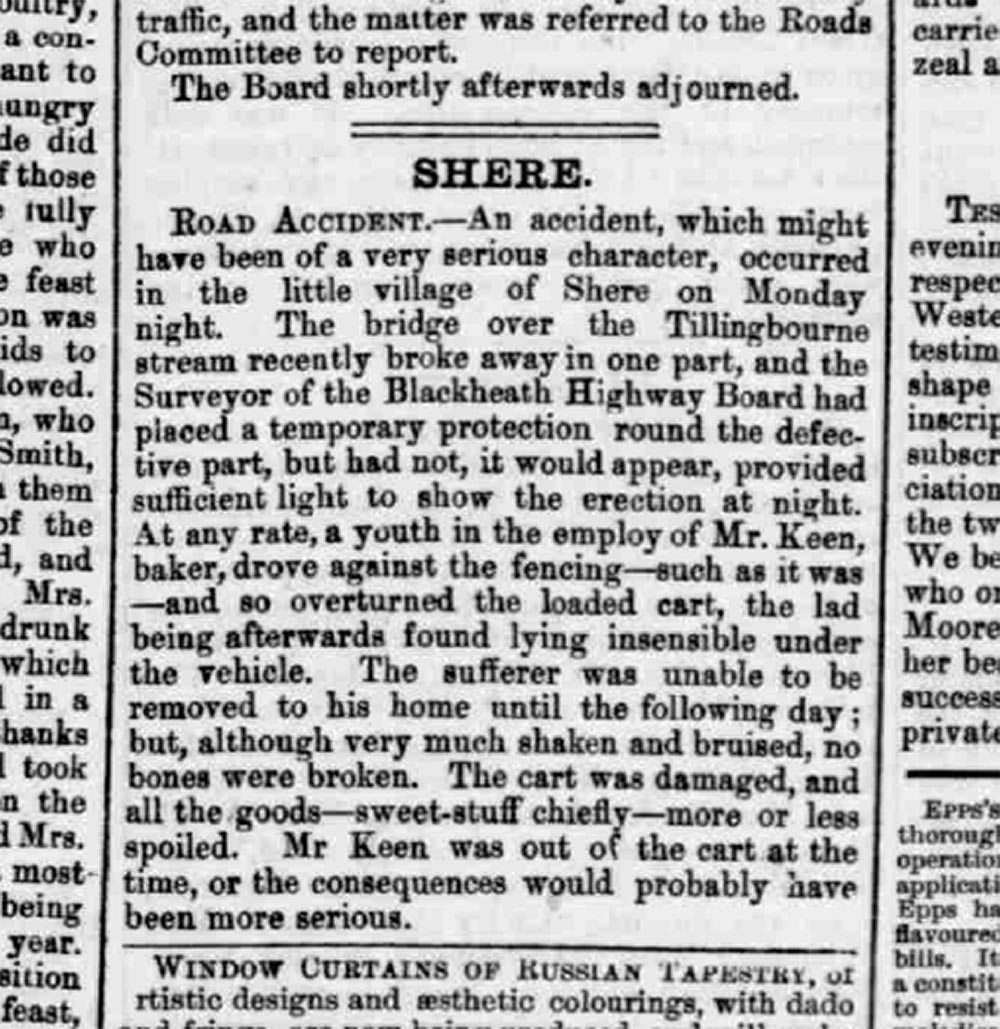
1882Surrey Mirror - Saturday 07 January 1882
First Road Accident recording in Shere
Full page view Images © THE BRITISH LIBRARY BOARD. ALL RIGHTS RESERVED.
|
||||||||||||||||||||
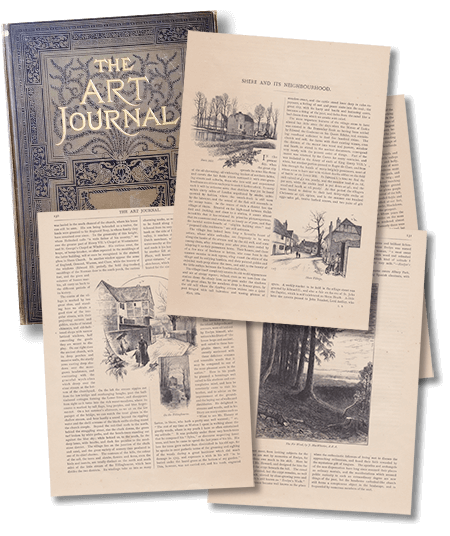
1882 - Shere and its neighbourhood
THE ART JOURNAL - May 1882 This 130 year old 4-page article makes interesting reading, published in the Victorian publication, The Art Journal. Exciting also to see sketches of Shere Mill (Netley Mill), Shere Village (The Square and Lower Street). READ ARTICLE: |
||||||||||||||||||||
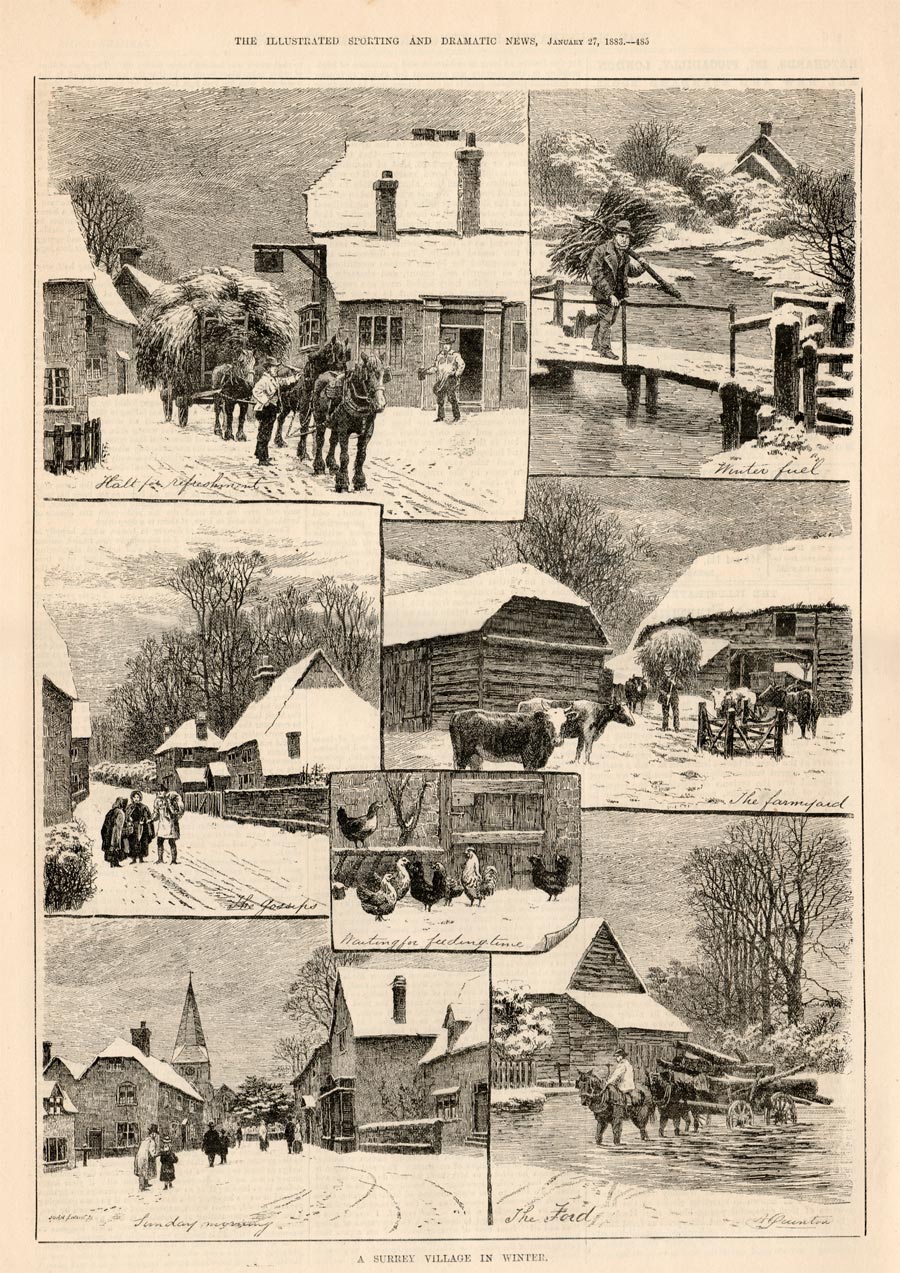
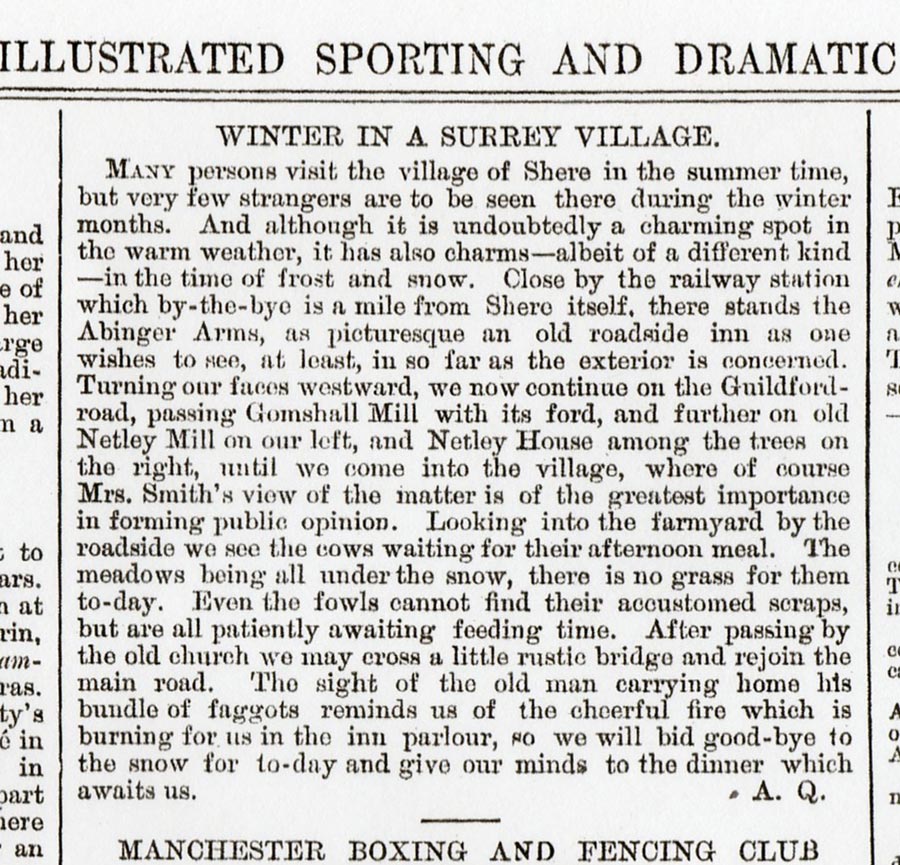
1883
The Illustrating Sporting and Dramatic News - January 27th 1883
A Surrey Village in Winter Description - LARGER VIEW |
||||||||||||||||||||
1886
|
||||||||||||||||||||
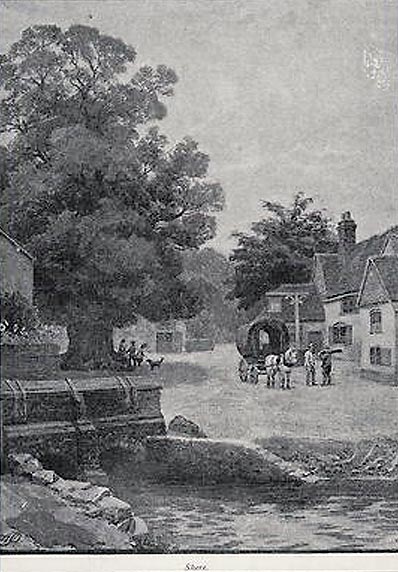
1893 - The Pilgrim's Way
Title: 'SHERE' Print measure 9 inches by 7 inches. The art is by the highly acclaimed and hugely prolific artist, A. R. Quinton. Source: The Pilgrims' Way, 1893. BOOK PLATE - 1893 |
||||||||||||||||||||
1898
Shere Parish Hall in Surrey, which was built to commorate Queen Victoria's Diamond Jubilee in 1898. When the men of Shere returned from serving in the First World War the Parish wished to honour them, by building and completing the present Village Hall in 1922 (the white building in photo above). The then Original Parish Hall (the current location of the Shere Museum), was built to commemorate Queen Victoria's Diamond Jubilee in 1898 then became available for The Shere Working Men's Club. The Shere Working Men's Club closed in 1997 and the hall lay empty until 2006 when a team of volunteers started work on converting the building to house the museum collection. |
||||||||||||||||||||
1904 - Train Crash
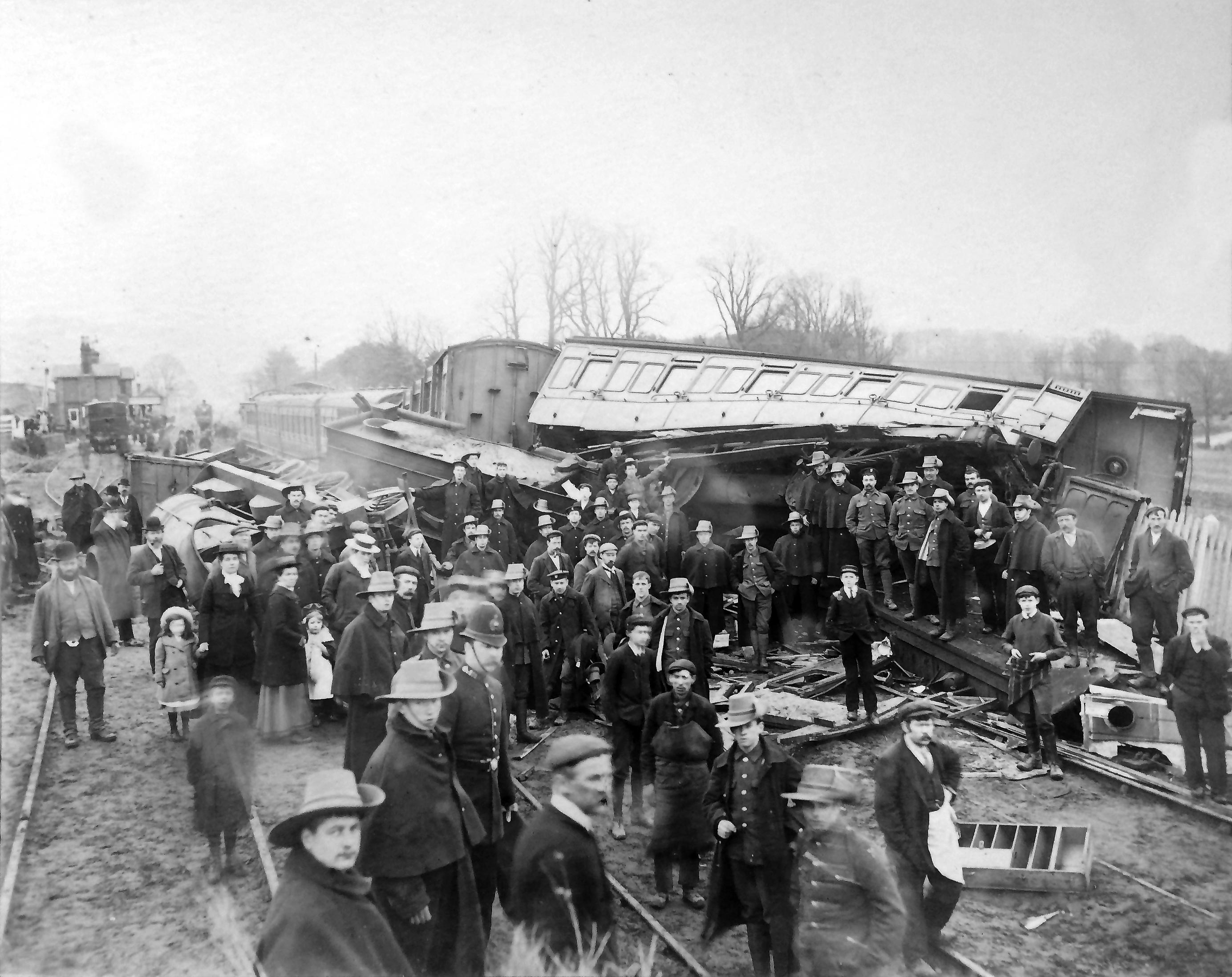
20th February 1904: A serious railway accident occurred as a troop train was passing through Gomshall Station. Although the engine and two coaches were overturned and smashed after the engine had left the rails, no one was killed but several soldiers and the driver and fireman of the train were severely injured. |
||||||||||||||||||||
1906
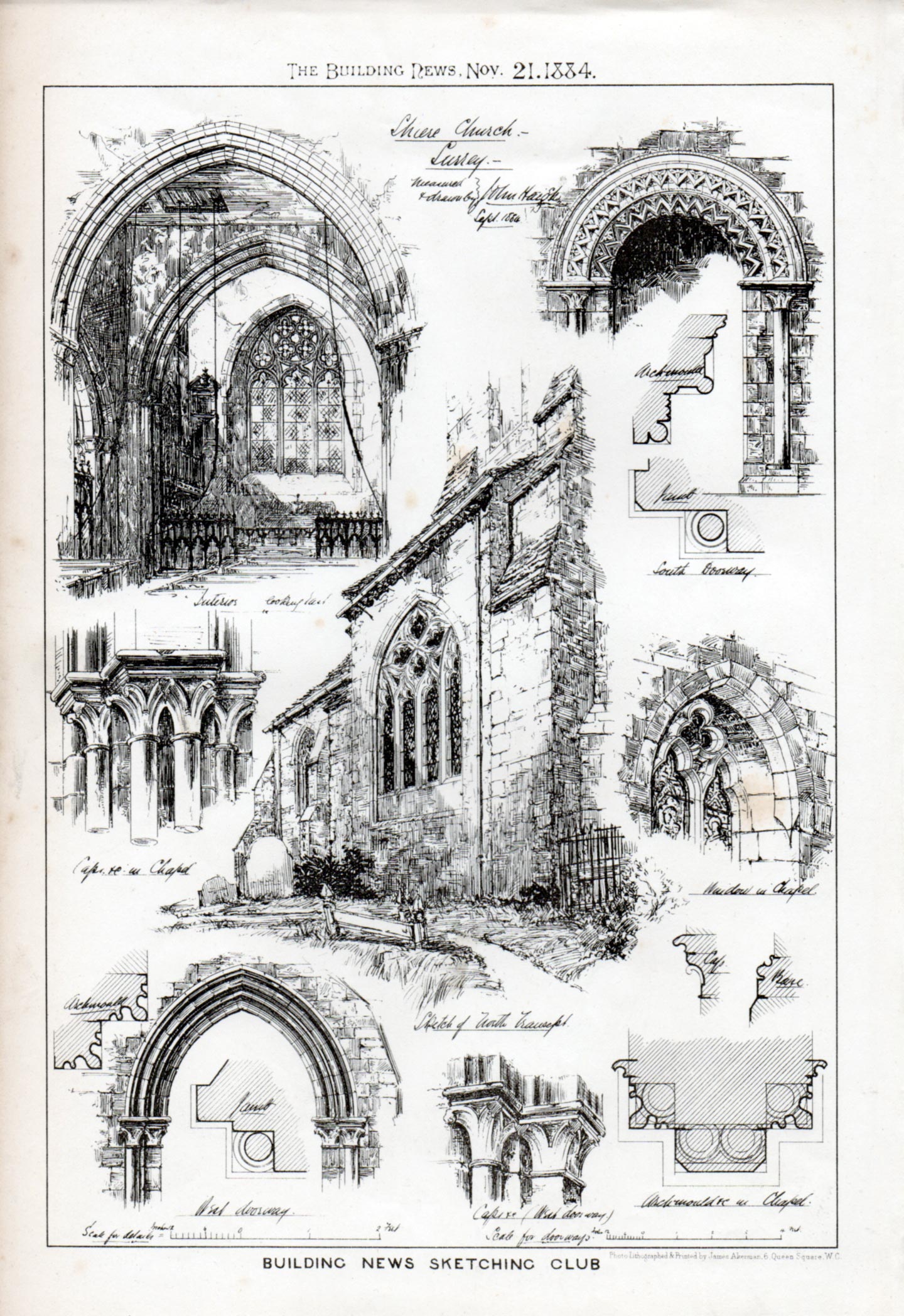
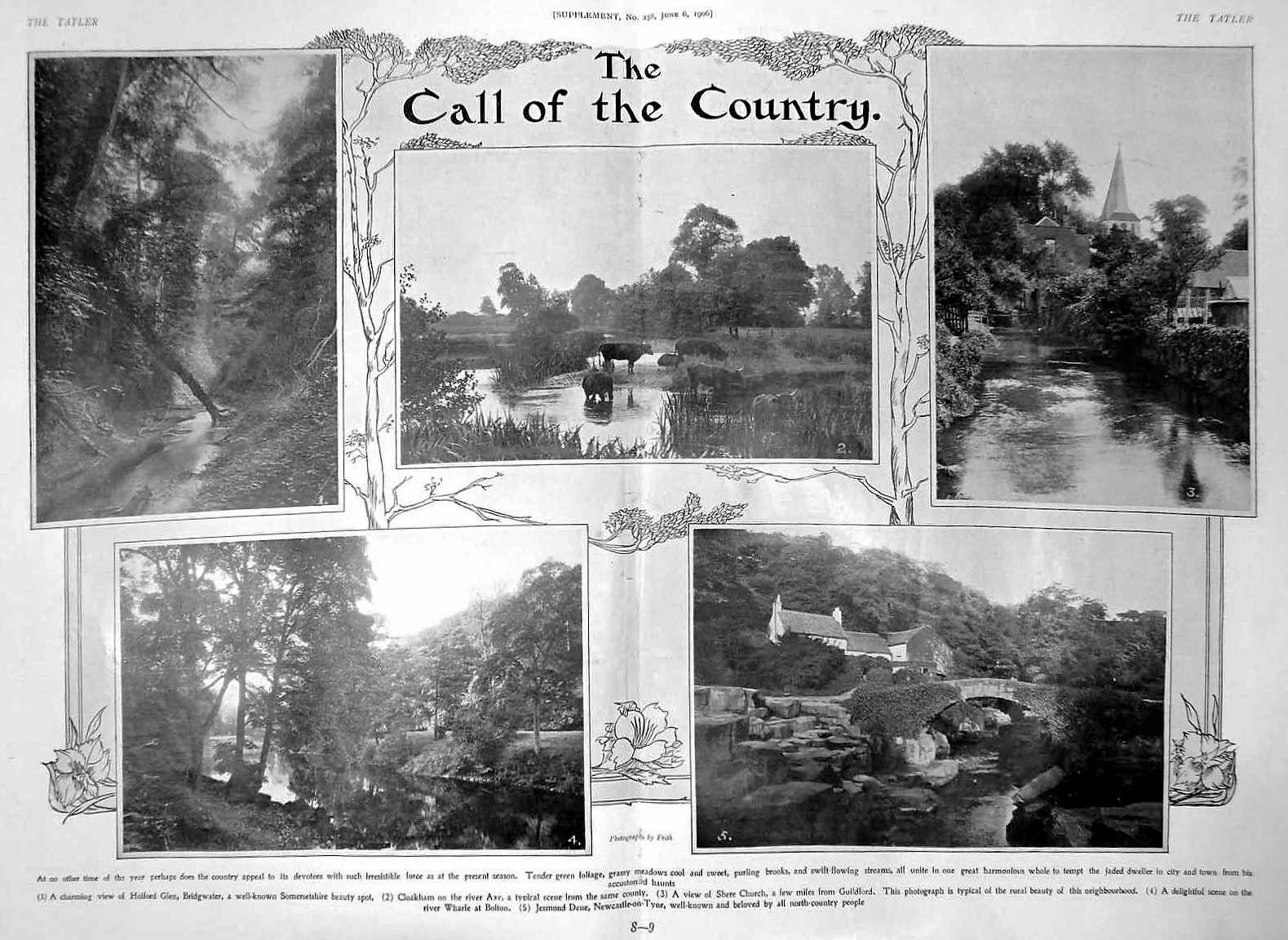
THE TATLER - June 6th 1906 Photo 3: A view of Shere Church, a few miles from Guildford. This photograph is typical of the rural beauty of this neighbourhood |
||||||||||||||||||||
1906
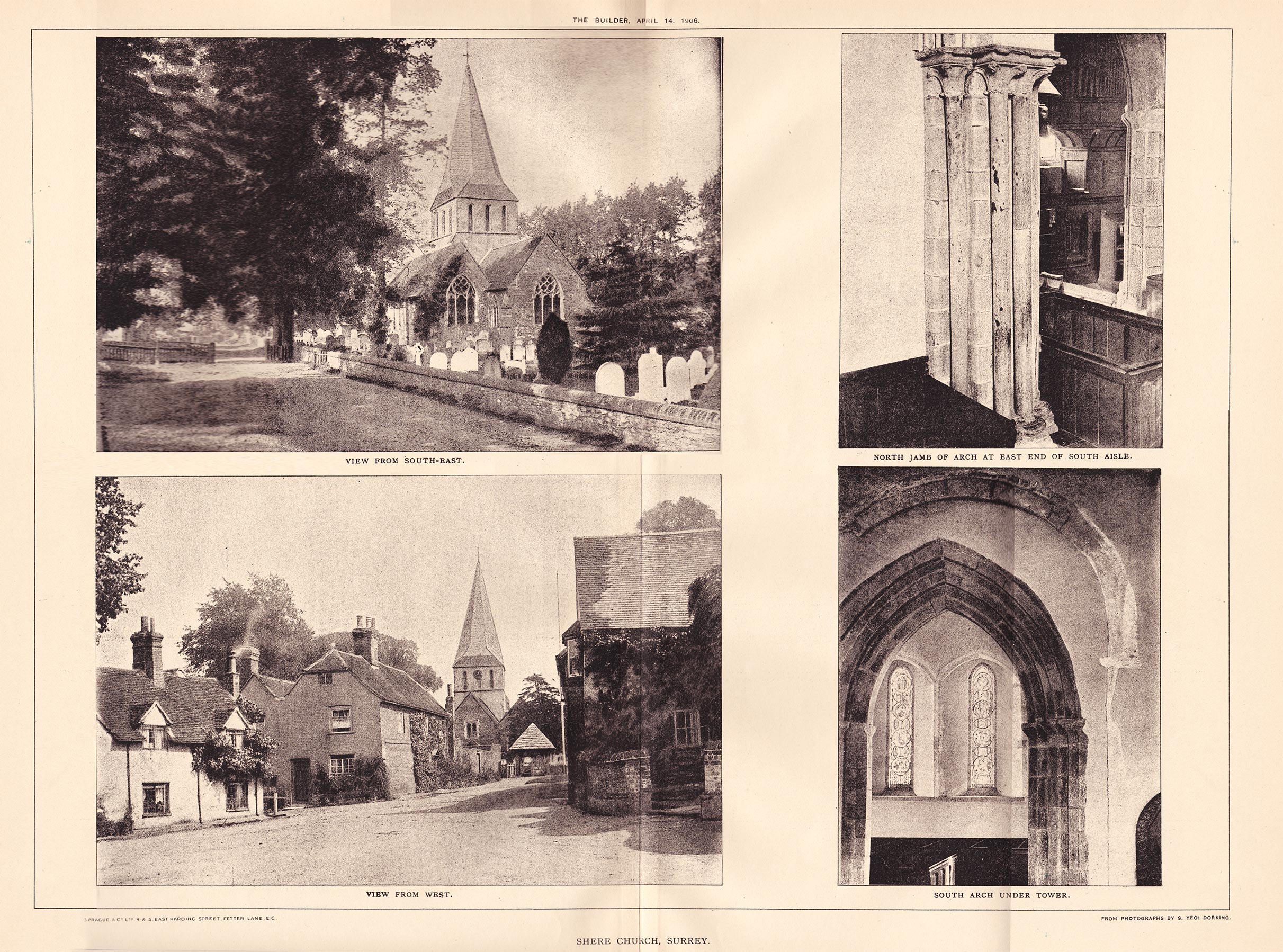
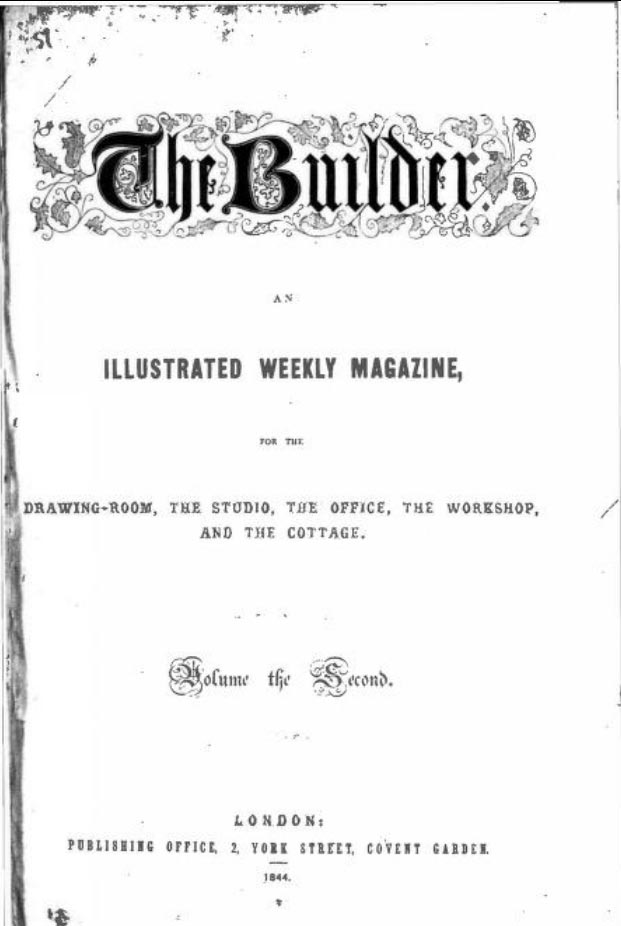
The Builder - April 14 1906
The Builder was a weekly magazine which began publication in 1843. It absorbed another journal titled "Architecture". In 1966, the journal ceased publication, and was continued by a journal named "Building". 20th February 2017 |
||||||||||||||||||||
1908 - London Olympic high jump and hurdlesEdward Eastlake Leader was the son of celebrated artist After winning the high jump for Cambridge vs. Oxford in 1904, Edward Leader shared second place in the Oxbridge vs. Harvard/Yale match. The following year, he finished second at both the Oxbridge Sports and at the AAAs. Although he did not win a blue as a hurdler, he was chosen to represent Britain in the 110 hurdles at the 1908 Olympics. He was Called to the Bar in 1908 and practiced as a barrister - source REPORT: Athletics at the 1908 London Summer Games Edward Leader finished 10th position with a height of 1.77m Otto Monsen (NOR) and Edward Leader (GBR) had shared first place in the original competition, but Monsen refused to take part in the re-scheduled event, while Leader failed to match the height he had achieved in the less favorable conditions. The only beneficiary of the protest was Gidney himself - Source
© source - Fair Dealing |
||||||||||||||||||||
1908 / 1909
Extract from Highways and Byways in Surrey The White Horse is a pattern of an old village inn, with panelled rooms and dark beams over its ceilings, and a parlour hung with oil paintings, |
||||||||||||||||||||
1910Published just over 100 years ago in 1910
|
||||||||||||||||||||
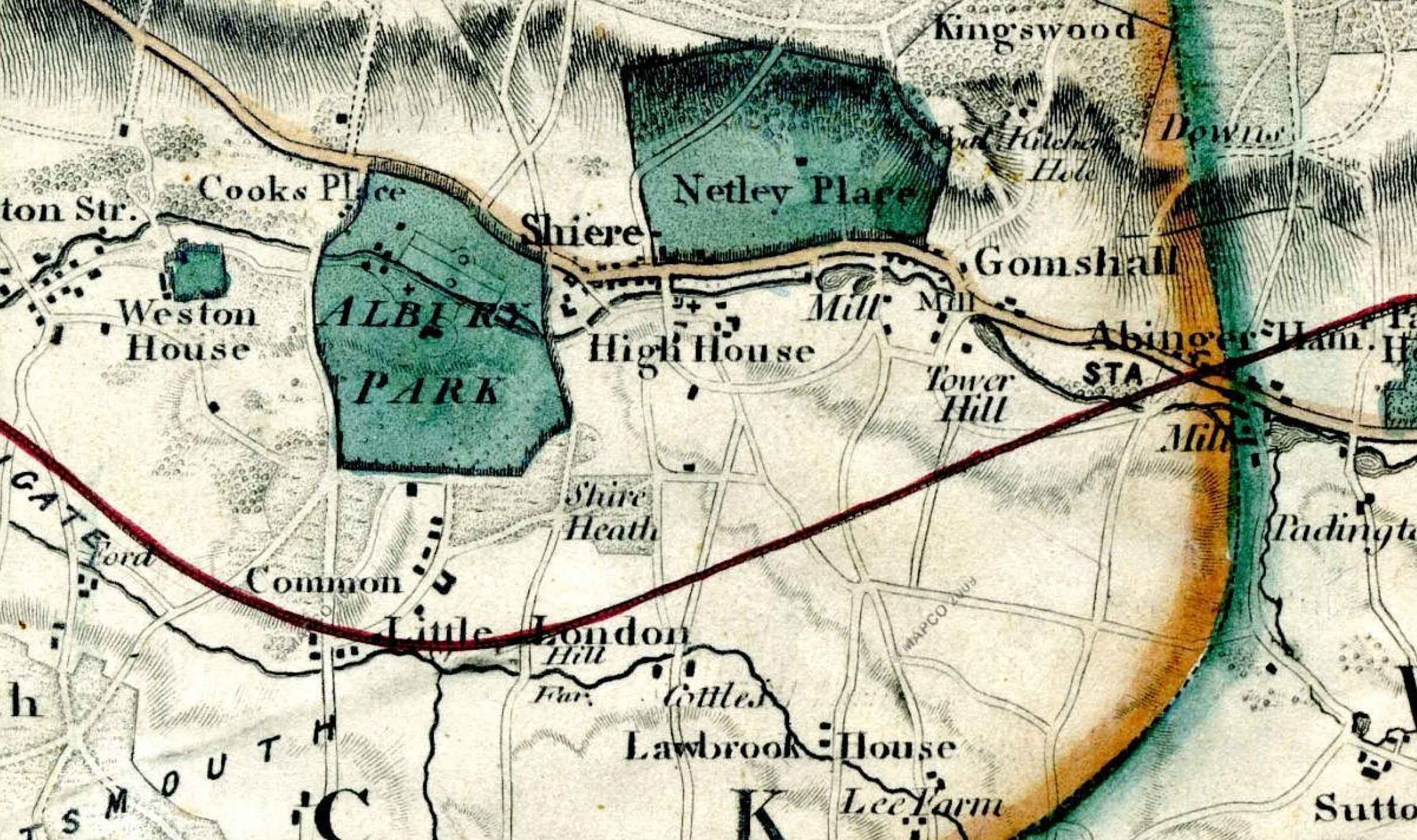
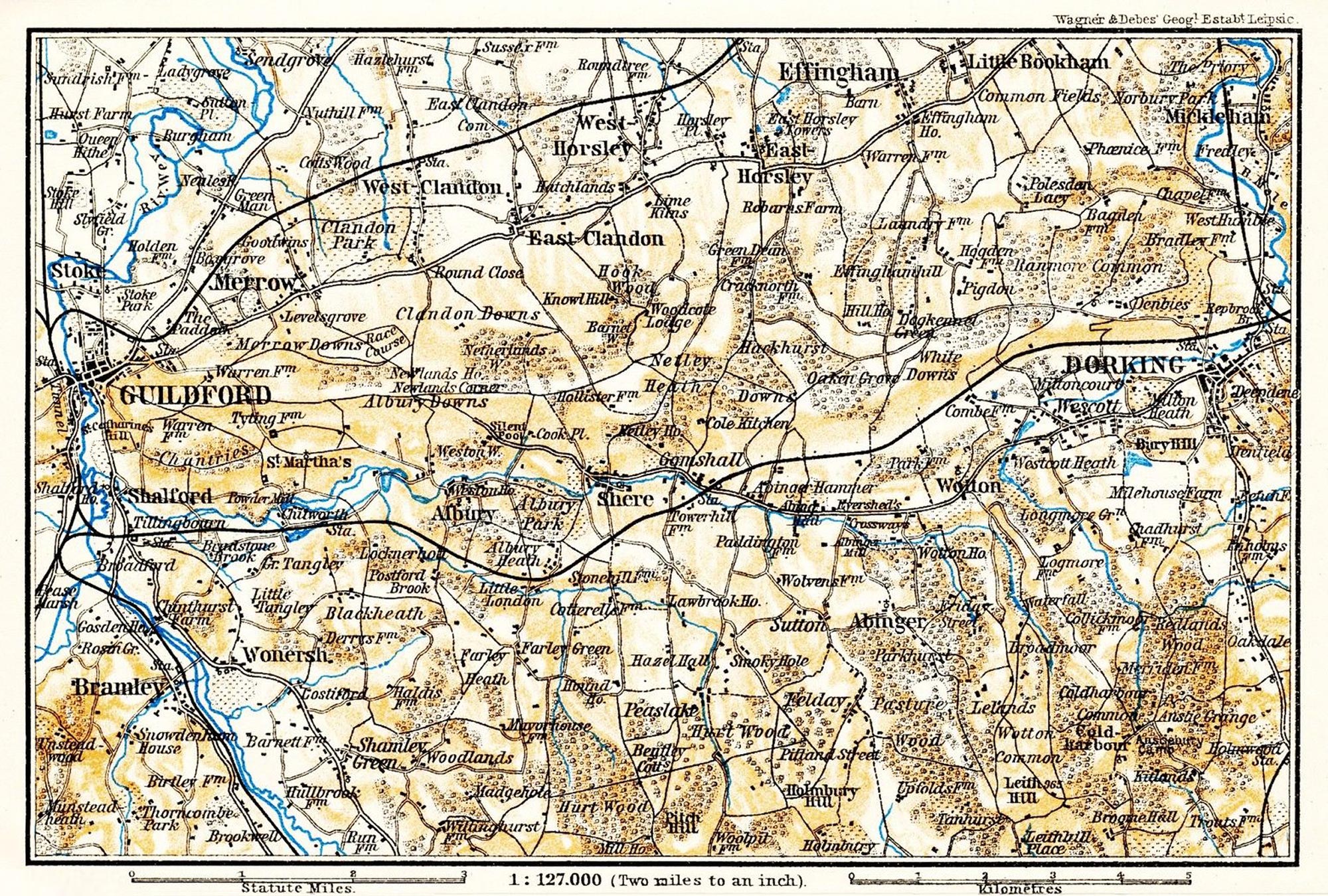
1910 - Map
Old 1910 Map showing Guildford to Dorking with Shere in the centre |
||||||||||||||||||||
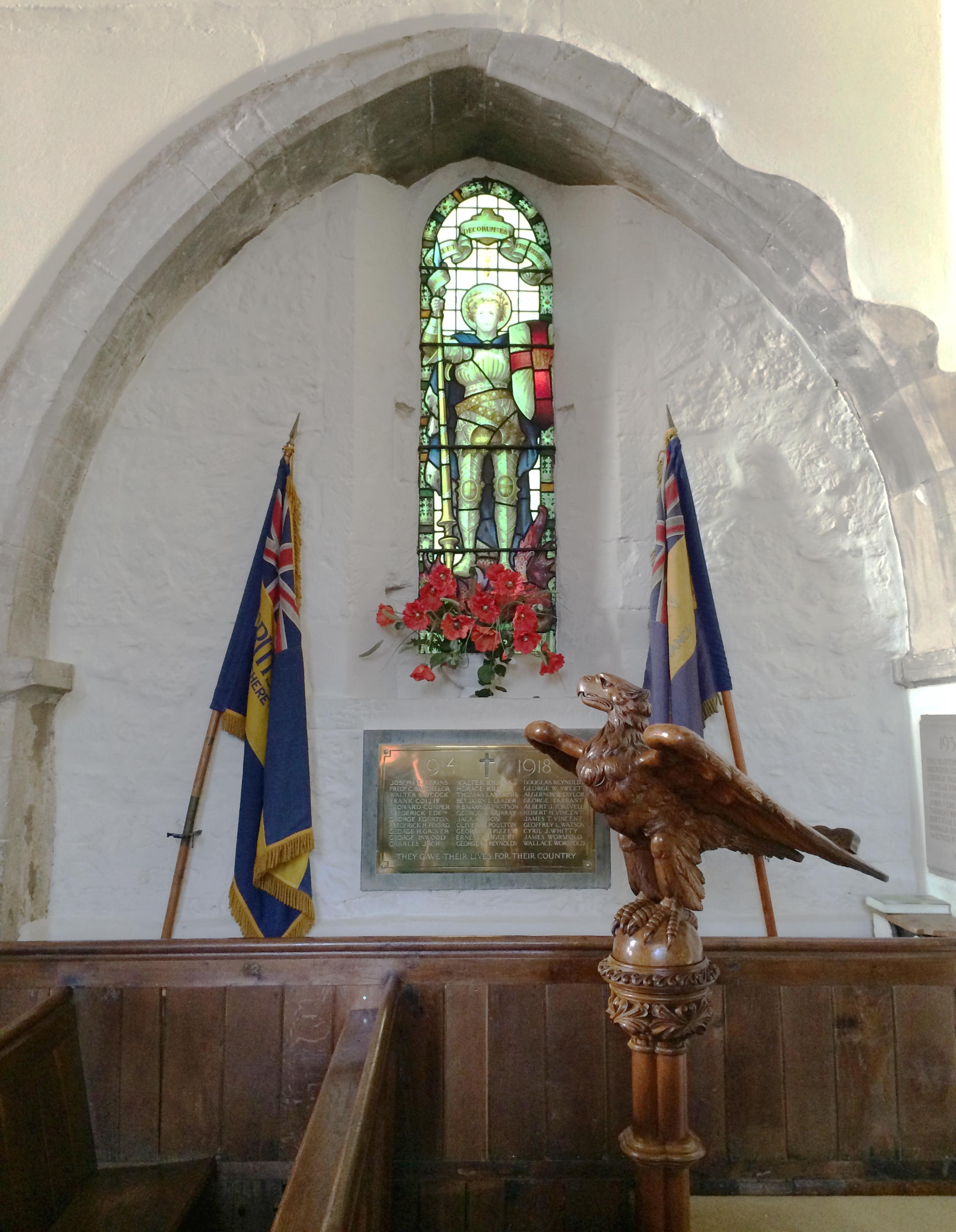
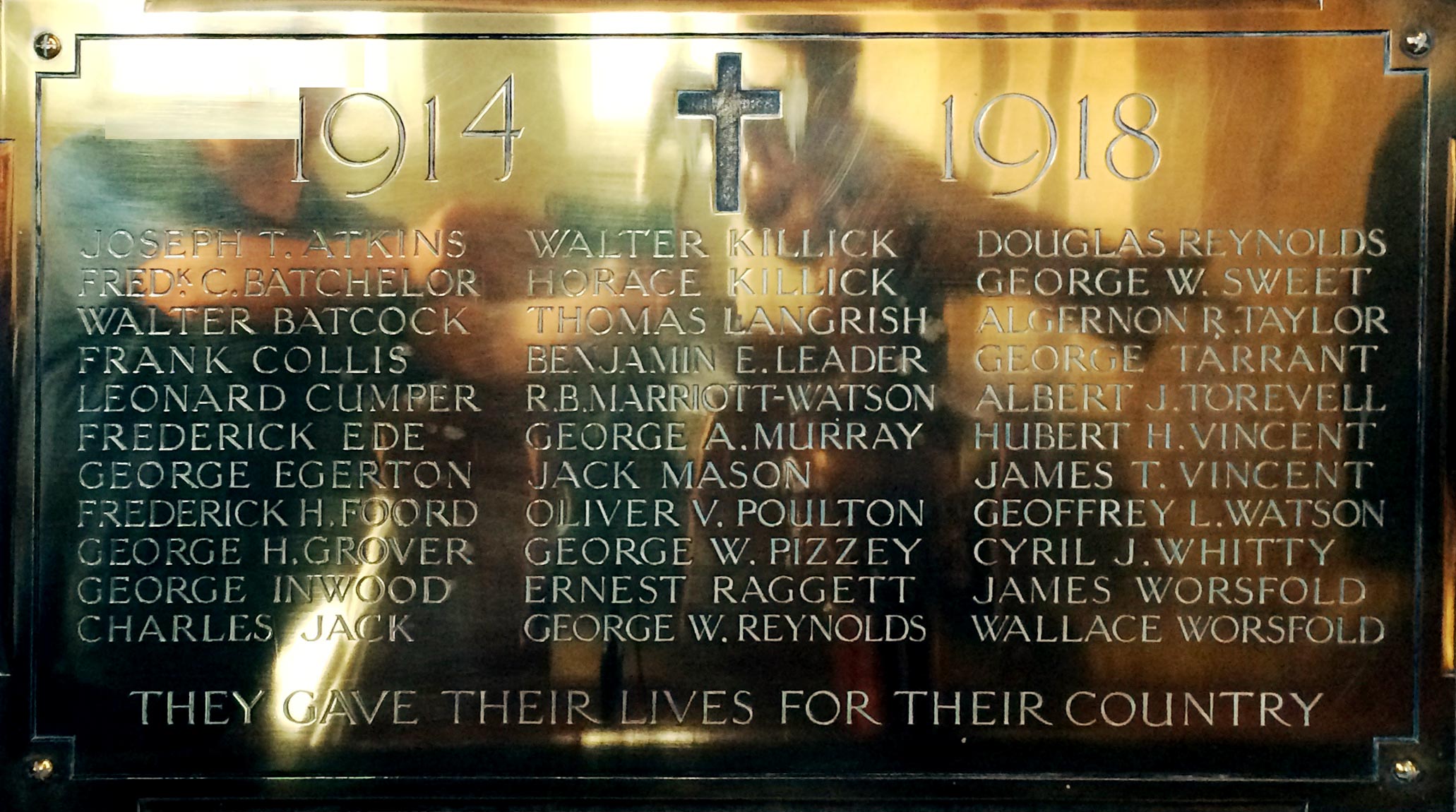
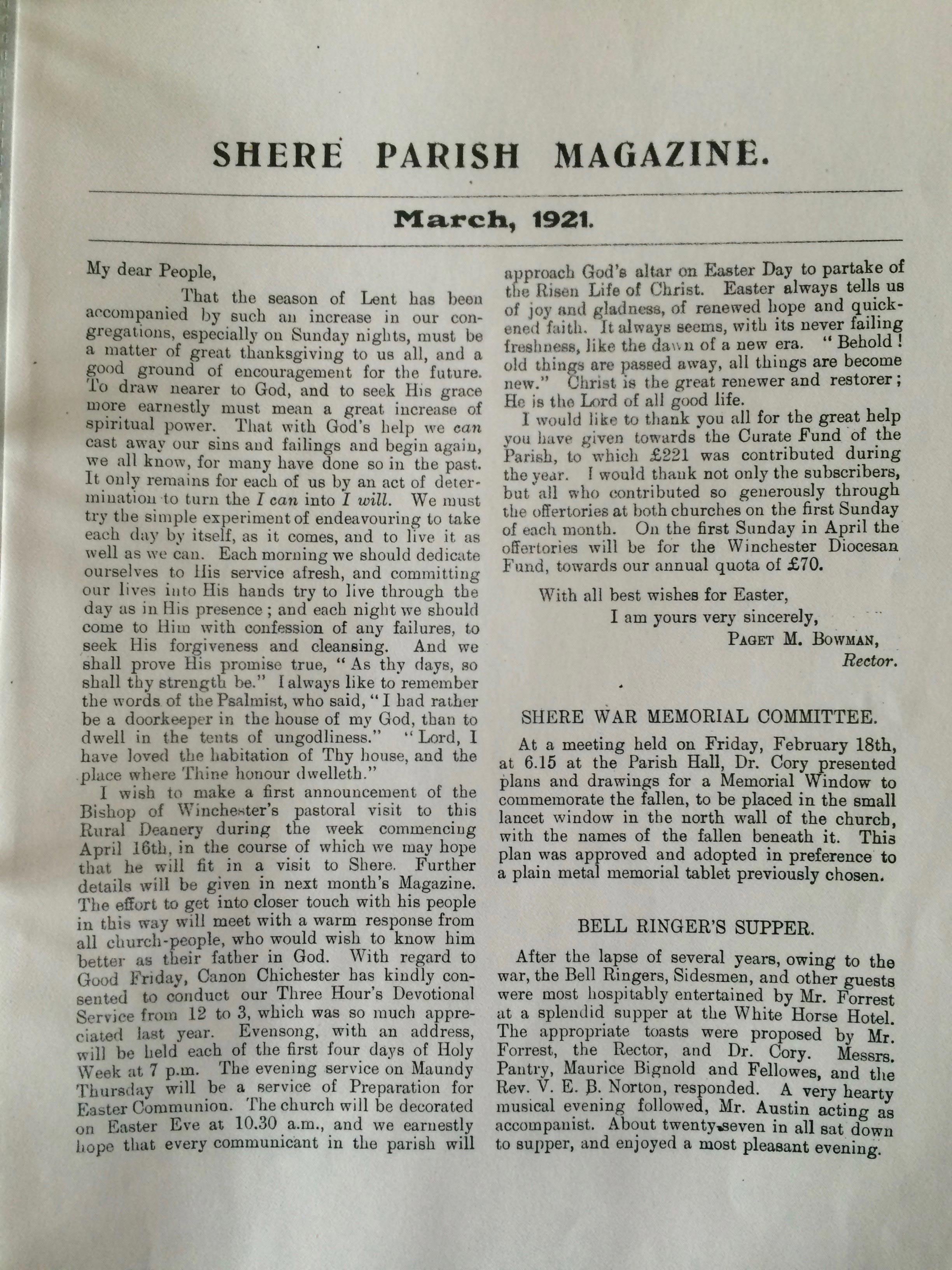
1914/18Shere village war memorial consists on a 'nameless' stone cross to the west of the St James's Church, and a bronze plaque bearing the names of the fallen on the inner northern wall of the church.
|
||||||||||||||||||||
1916 Magazine Cover
The front cover of a September 1916 Light Car & Cyclecar magazine. The vehicle passing underneath the footbridge is a period Morris Cowley, registered and manufactured in Oxford. The Light Car & Cyclecar magazine was first issued in November 1912. Many thanks to Peter Card - More info on the: |
||||||||||||||||||||
1916 - Red Cross - Surrey Division
|





 United States
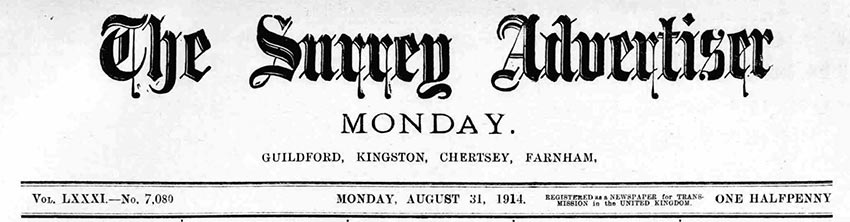
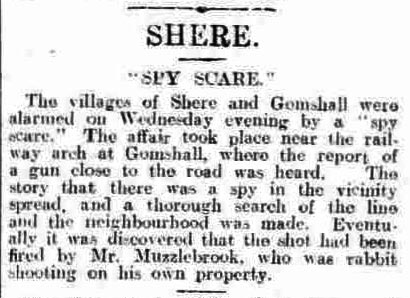
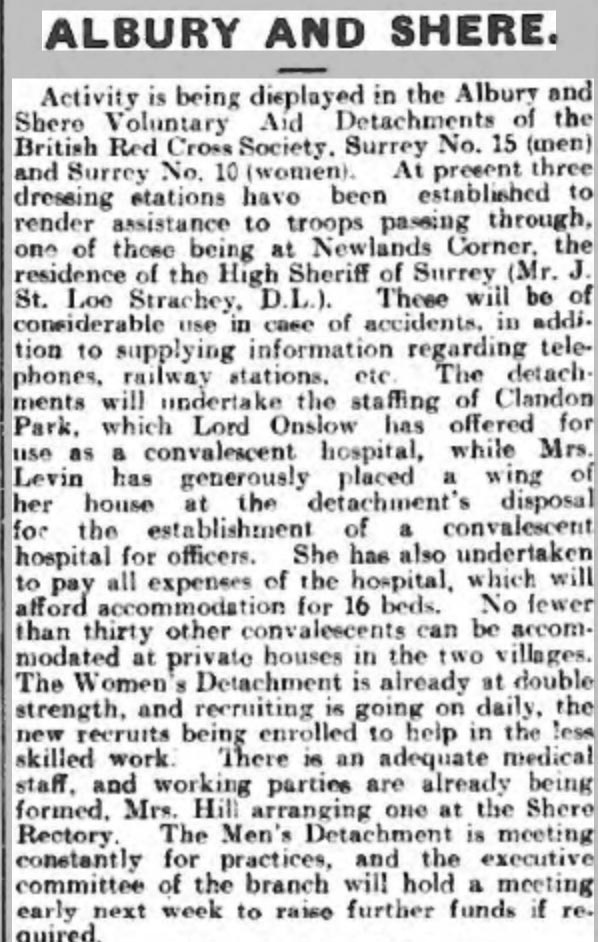
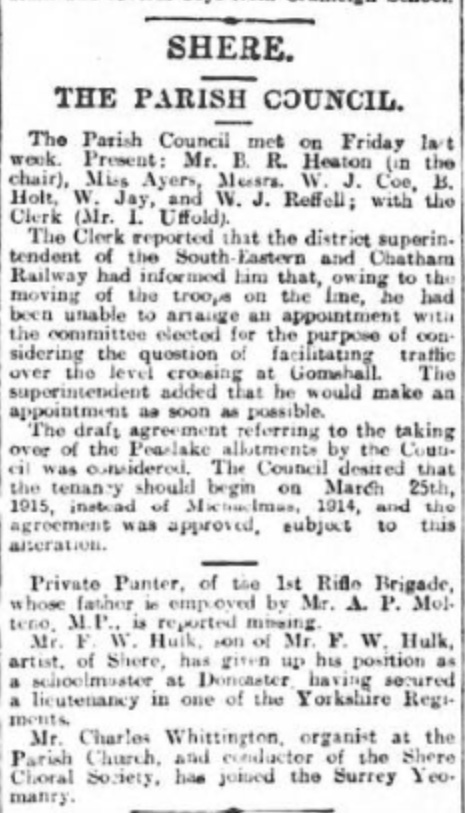

 |
Albury and Shere Division - click to read You can see that Dr Isaac Rising Cory is part of the Red Cross team. Dr. Cory was an extremley important figure in the village of Shere. As well as being the village Doctor, Dr. Cory was associated with the Shere and Albury Fire Brigade. He was also a founder members of the local scout troop which was one of the earliest to be formed (You may be interested to read Shere resident's Stan Longhurst and Stans brother were also founder members - Read about Stan HERE) Dr Isaac Rising Cory also designed the Village Hall and the Village Swimming Pool. Dr. Cory must have been influenced by his uncle as he was the nephew of architect John Augustus Cory (1819-1887). John designed Durhams city swimming baths in 1855 (situated behind the Waterloo Hotel is Elvet Waterside, now with new housing). (source) Dr. Cory, was also the Holmbury St Mary WW1 PRISONER OF WAR CAMP physician - see OCTOBER 1917 entry below |
12th October 1916
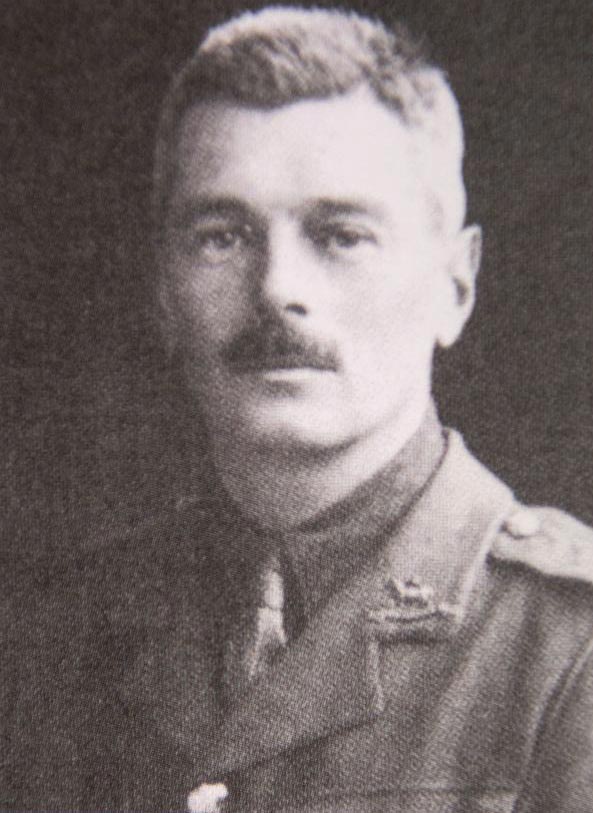 photo©BNPS Fair Standard
Sadly news comes of Capt. Benjamin William Leaders eldest son, also a celebrated artist and known as exhibitor at the Royal Academy.
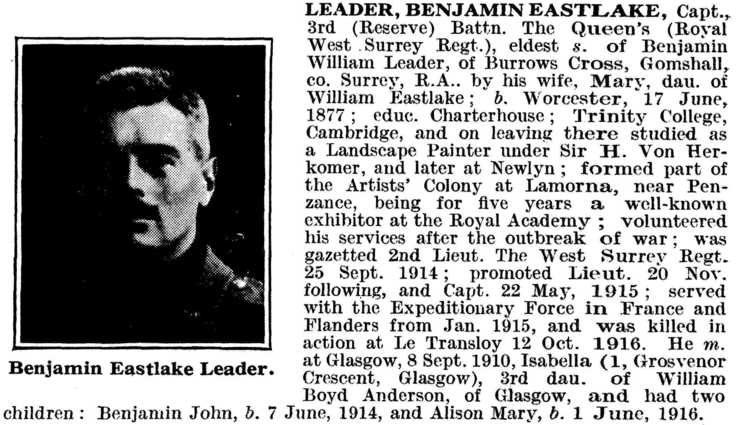
Details: Capt Benjamin Eastlake Leader - Queen's (Royal West Surrey Regiment) - 3rd Battalion
Burial: Thiepval Memorial Thiepval Departement de la Somme Picardie, France. Plot: Pier and Face 5 D and 6 D.
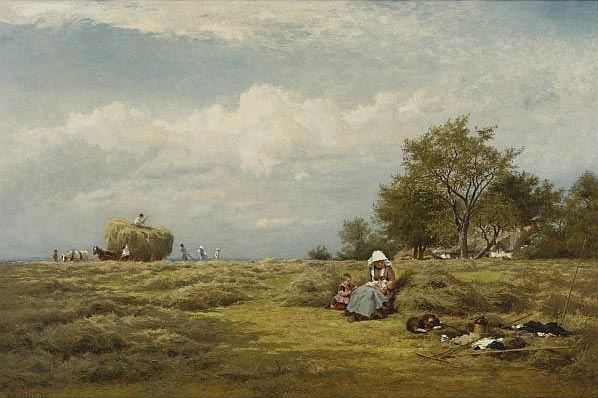
The above painting titled "An English Hayfield" was by his father in Benjamin Williams Leader in 1879 and in the artist notes he figures were posed for by his wife, their young son Benjy (Benjamin Eastlake Leader) who was two years old at the time and their baby daughter Ethel. The scene depicts a hayfield at Whittington, the village in Worcestershire where Leader resided between 1862 and 1889 before moving to Burrows Cross, Shere.
Benjamin Eastlake Leader's son, also named Benjamin, 116403 Pilot Officer Benjamin John Leader, served in the RAF (Royal Air Force Volunteer Reserve) in the Second World War and lost his life on the 4th August 1942 aged 28. READ MORE under the 1942 section below.
Benjamin Eastlake Leader Siblings:
His sister, Ethel Leader born 23 Jul 1878 in Whittington Lodge, Whittington, Worcestershire - Died 1 Dec 1974 in North Walsham, Norfolk. Married Roland James the year before her brother died on May 8 June 1915 in St. James' Church, Shere.
Sister Margaret Isabella Leader born March 1896 in Guildford, Surrey England died 12 Oct 1910.
Sister Mary Eastlake Leader born 19 Nov 1880 in Whittington, Pershore, Worcestershire.
Married Archibald Montgomery Tringham 17 February 1906 at St. James' Church, Shere.
Mary died 13 May 1977.
Sister Beatrice Leader (unmarried) - Born 28 Nov 1879 in Whittington, Lodge, Whittington, Worcestershire.
Death 16 Sept 1975 in Surrey, aged 95 years.
WE HAVE AN OLYMPIAN connection
Brother Edward Eastlake Leader
born. 28 Aug 1882 in Whittington, Lodge, Whittington, Worcestershire died 22 April 1959.
1908 - London Olympic high jump and hurdles
Edward represented Great Britain - Olympic Games 1908 - High Jump and Hurdles. The United Kingdom was the host nation of the 1908 Summer Olympics in London, 104 years before we were to host again at the 2012 London Olympics. In 1908, the UK was ranked first with a total of 146 medals: 56 Gold, 51 Silver and 39 Bronze medals
After winning the high jump for Cambridge vs. Oxford in 1904, Edward Leader shared second place in the Oxbridge vs. Harvard/Yale match. The following year, he finished second at both the Oxbridge Sports and at the AAAs. Although he did not win a blue as a hurdler, he was chosen to represent Britain in the 110 hurdles at the 1908 Olympics. He was Called to the Bar in 1908 and practiced as a barrister - source
For the Full Olympic Report and how Edward Eastlake Leader got on representing Great Britain, scroll up to the 1908 - London Olympics.
The London Gazette shows Edward's rank in the first World war, sadly ten months before his brother, Benjamin Eastlake Leader, is killed - see above.
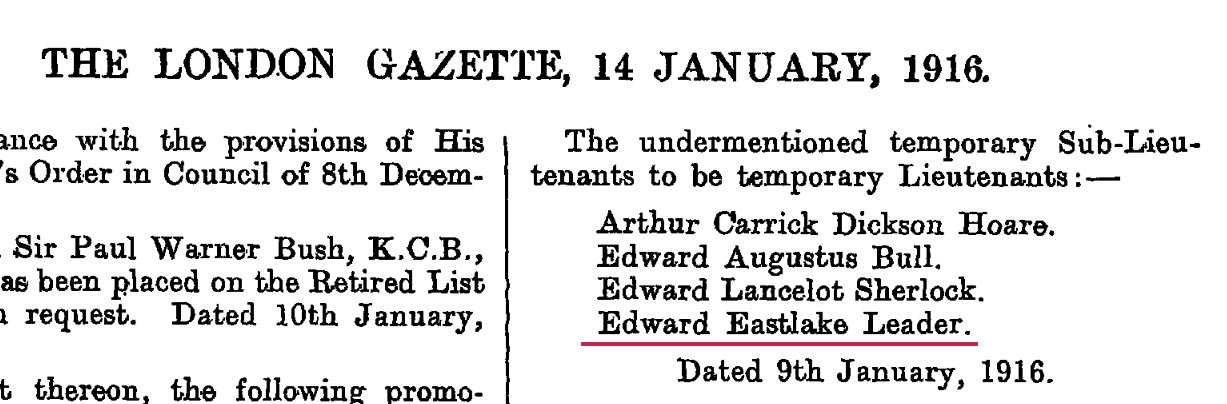 Royal Naval Volunteer Reserve
Source

Both Benjamin Eastlake Leader and Edward Eastlake Leader are mentioned on the Charterhouse school website:
Benjamin: Captain / The Queen's (Royal West Surrey Regiment),3rd Bn. attd. 2nd Bn. Duke of Wellington's (West Riding Regiment), Infantry - Died on 12 October 1916
He was the eldest child and first son of Benjamin W. Leader, R.A., landscape painter, and Mary Alexandra Leader (nee Eastlake) of Burrows Cross, Gomshall, Guildford. He had four sisters and a brother. He was married in 1910 to Isabella (Belle) (nee Anderson), of Rosemerryn, Bude, Cornwall, with whom he had two children.
He was a talented artist as a schoolboy and was awarded the Leech prize for drawing 1895; several of his drawings were published in ‘The Greyfriar’ magazine. He went up to Trinity, Cambridge and afterwards became an artist, specializing in landscapes, and a member of the artists’ colony at Lamorna.
He served with the Expeditionary Force in Flanders from 14 January 1915 and was killed in action at Le Transloy. He is commemorated on the Thiepval Memorial, and also at St Buryan’s Church, Cornwall.
Edward: His younger brother Edward Eastlake Leader, was in Pageites 1896-1900; he competed at the Olympics in 1908 in high jump and hurdles. He became a barrister, survived service in the RNVR and died in 1959. Charterhouse Roll of Honour, a website commemorating all those Old Carthusians and members of staff who perished in the First World War © 2017 Charterhouse
Charterhouse school is an independent day and boarding school in Godalming, Surrey. Founded by Thomas Sutton in 1611 on the site of the old Carthusian monastery in Charterhouse Square, Smithfield, London
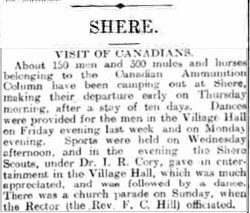
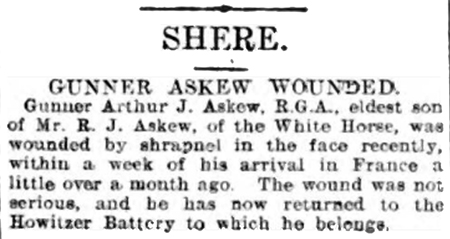
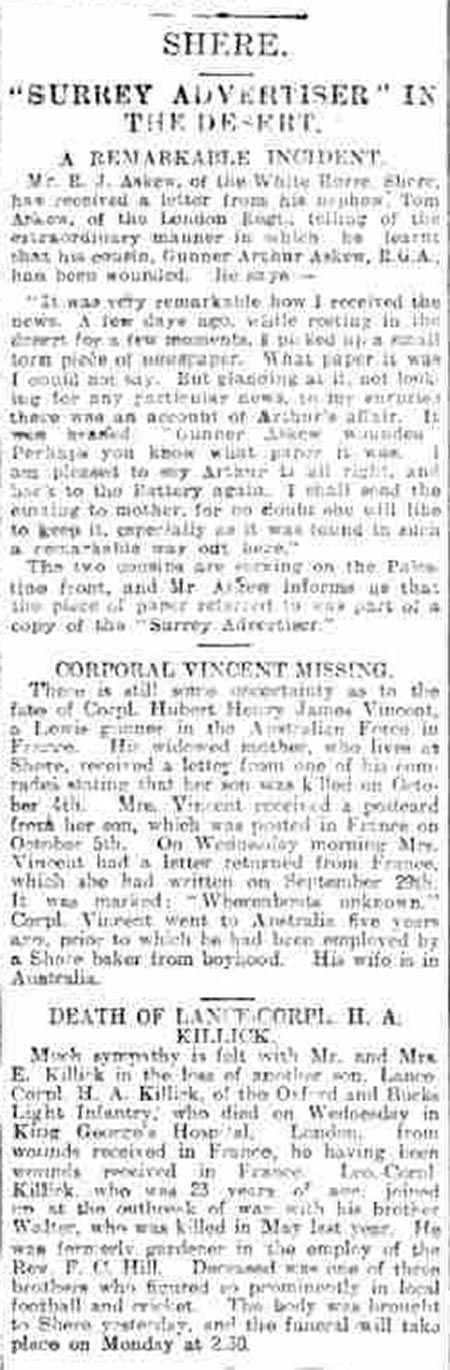
October 1917 - WW1 Prisoner of War Camp at Holmbury
1918 - World War I Gun and shell
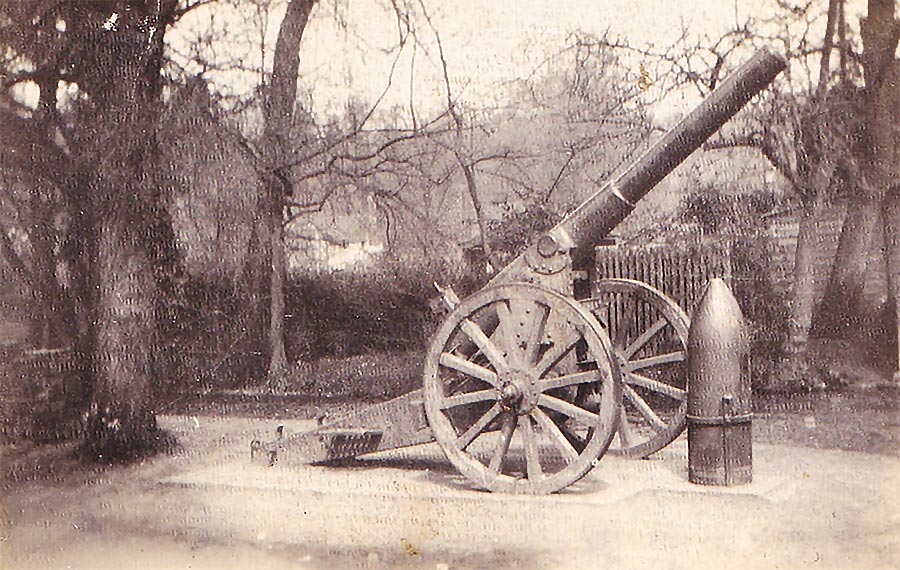
This Gun and shell sat next to the tillingbourne in Shere until World War II where it was taken and melted down for the war effort - The gun can be viewed in many old postcards leading up to this time.
November 1920 - Shere War Memorial design
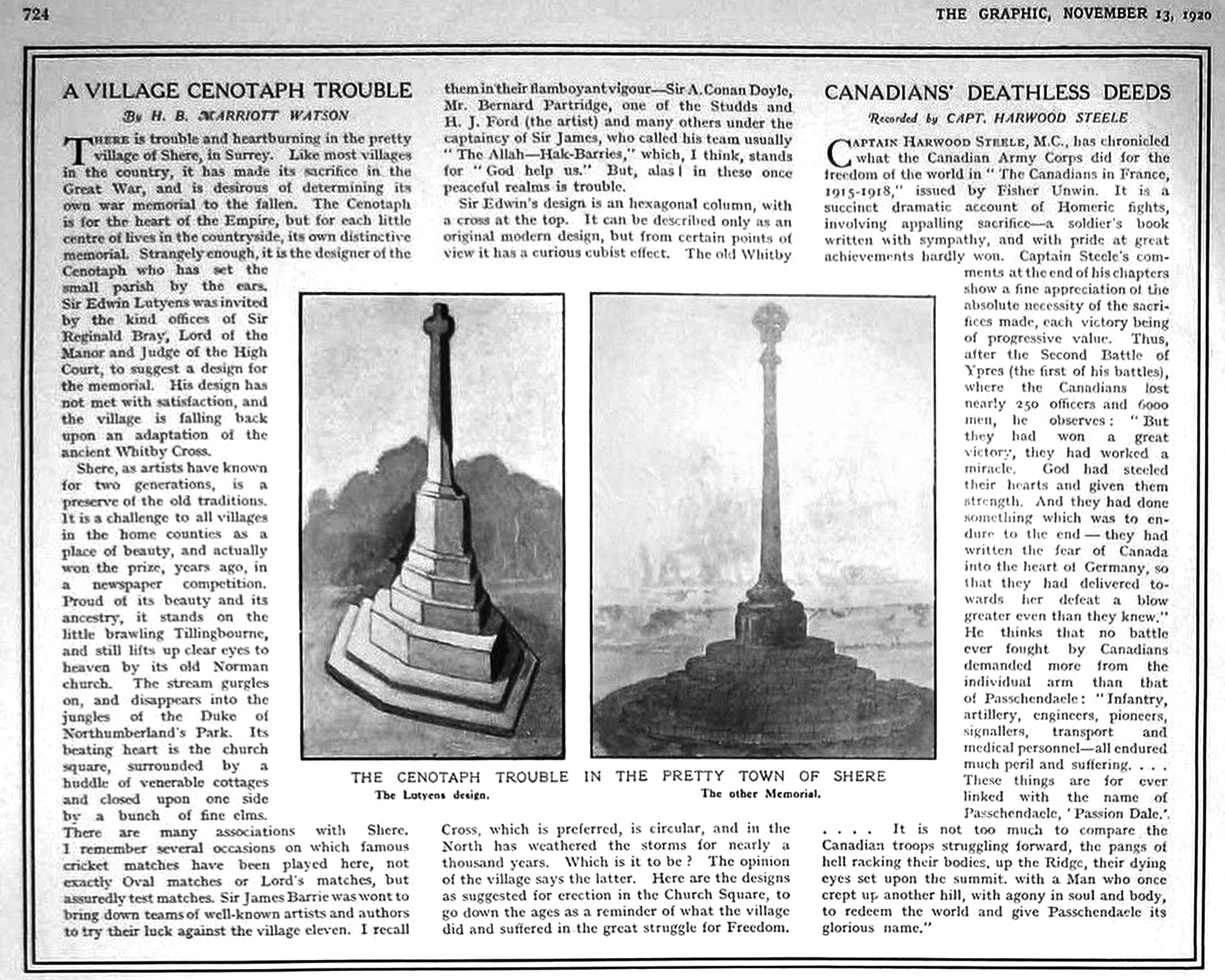
A VILLAGE CENOTAPH TROUBLE
The Graphic - November 13th 1920 - READ FULL ARTICLE
Interesting to see that Edwin Lutyens was invited to design the Shere War Memorial (a couple of days earlier the Lutyens designed) "The Cenotaph, Whitehall" in London was opened on 11th November 1920. The villagers of Shere however decided to turn their back onto the famous designer, who had designed various buildings in and around Shere:
1892 - Summers’ Barber’s Shop (now "The Dabbling Duck" tea rooms) was designed for Charles Summers, Barber & Shoemaker.
1892 - Lutyens’s cottages (Shere cottages) in Upper Street.
1894 - East Lodge with its prominent green gable.
1902 - Lych gate at the entrance to St James' Church
Two months later (Feb 1921) after the article was published, the War Memorial was unveiled in Shere
When the men of Shere returned from serving in the First World War the Parish wanted to honour them, by building and completing the present Village Hall. This was eventaully completed in 1922.
 click image to view
The then Original Parish Hall (the current location of the Shere Museum), was built to commemorate Queen Victoria's Diamond Jubilee in 1898 then became available for The Shere Working Men's Club. The Shere Working Men's Club closed in 1997 and the hall lay empty until 2006 when a team of volunteers started work on converting the building to house the village museum.
Feb 1921 - Shere War Memorial Cross
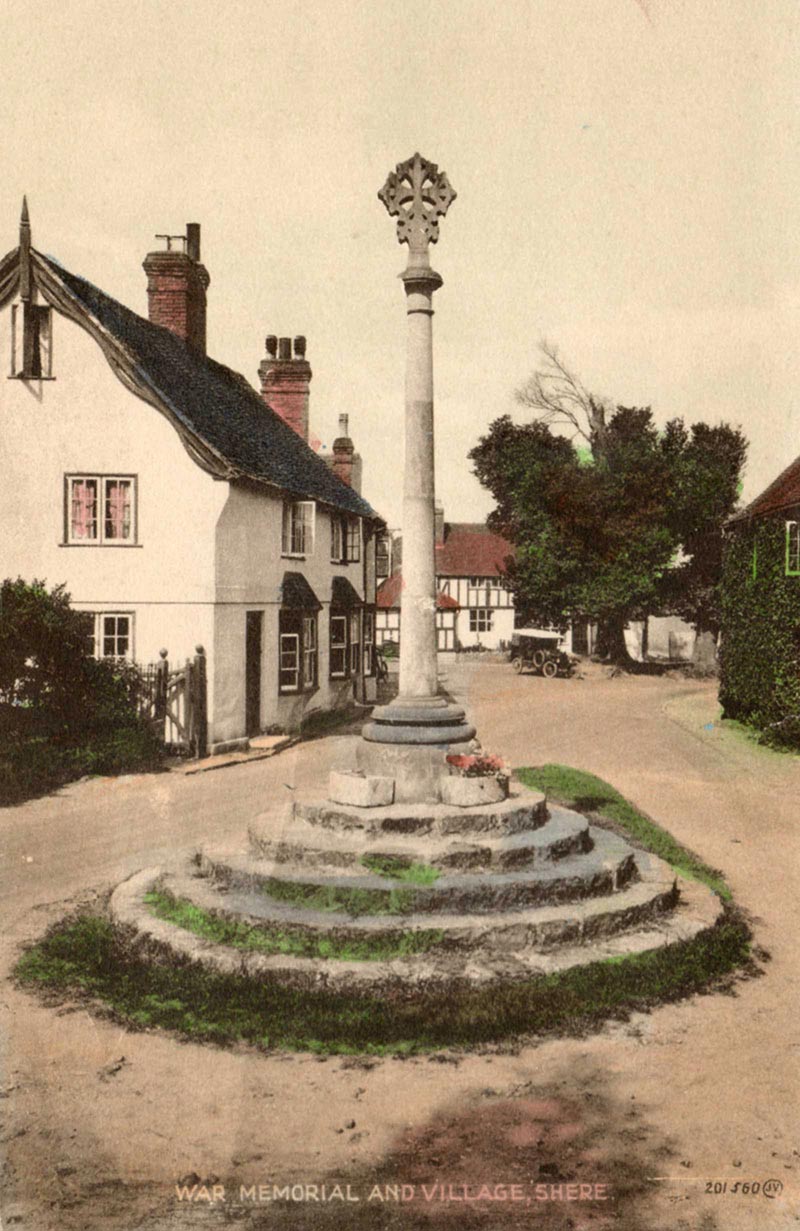
Unveiled on February 1921
First World War: 1914-1918
Second World War: 1939-1945 (South East Asia 1945-1946)
Floriated Maltese cross on cylindrical shaft, circular plinth and five stepped base
Located in The Square,
Shere,
Guildford,
GU5 9HG
OS grid: TQ 07443 47785

Benjemin Williams Leader - 1923
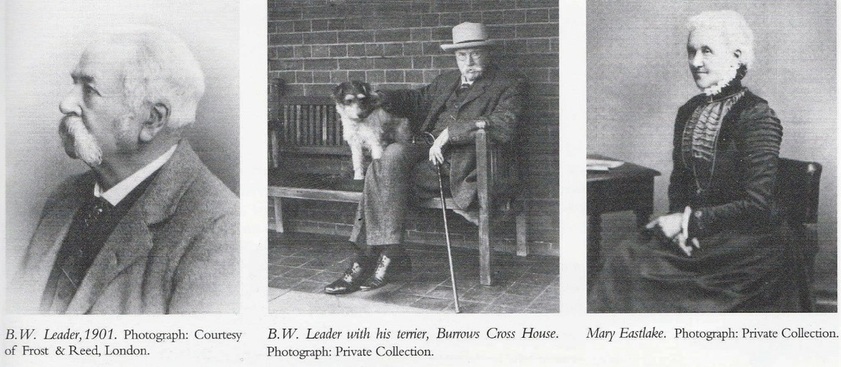
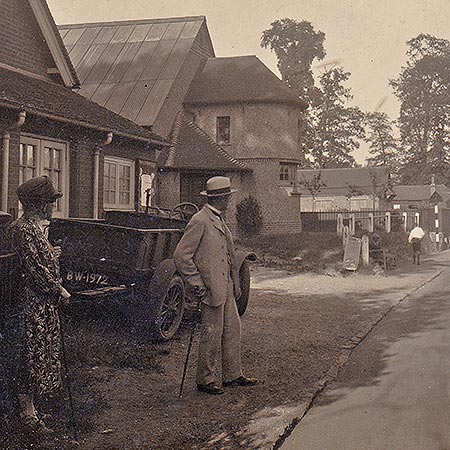
Benjemin Williams Leader died at his home "Burrows Cross House" on the 22nd March 1923. "Burrows Cross House was designed by Richard Norman Shaw in 1885 for Frank Roll and extended in 1889 by him for B.W. Leader. - © photo above of Benjemin and his wife, Mary Eastlake
Benjamin Leader was commercially successful during his lifetime, and had exhibited approximately 216 paintings at the Royal Academy over 69 years from 1854 to 1923. In addition to other London venues, Leader exhibited his works in exhibitions held in Worcester, Birmingham, Manchester, Liverpool and Glasgow (UK) as well as in international exhibitions in Paris (France), Canada and the United States.
"Benjamin William Leader was to become one of the most acclaimed Victorian landscape painters during his lifetime. He was born in Worcester in 1831 and he was the eldest of eleven children. His father, Edward Leader Williams was a civil engineer and staunch non-conformist whilst his mother Sarah Whiting was a Quaker. However after the two of them married in an Anglican church the Quaker establishment disowned them. Benjamin was actually born as Benjamin Williams but in 1857 he added the surname, Leader, which was his father’s middle name, to distinguish himself from the rest of the Williams clan. His father Edward was a keen amateur artist and was on friendly terms with John Constable. Benjamin would often accompany his father on his painting expeditions along the Severn valley and soon he developed a love of art. He attended the Royal Grammar School in Worcester and when he completed his schooling in 1845 was apprenticed as a draughtsman in his father’s engineering office. However Benjamin never gave up his fondness for apinting and drawing and after many discussions with his father he was allowed to leave the world of engineering and follow his love of art. His father gave his son one year to prove himself artistically. Benjamin enrolled at the Worcester School of Design and one year later had achieved the position of “probationer” at the Royal Academy Schools. A year on, and quite exceptionally for a first year student, he exhibited his first painting, Cottage Children Blowing Bubbles, which was bought by an American. From then on he exhibited in every Summer Exhibition of the Royal Academy up until 1922 when he had reached the fine old age of 91.
Leader married fellow artist Mary Eastlake in 1876. She was an artist whose subject speciality was flowers. She came from an artistic background being the grand-niece of Sir Charles Locke Eastlake who was President of the Royal Academy between 1850 until his death in 1865. The marriage of the couple did not find favour with her family as Benjamin Leader was twenty-two years older than their daughter and whereas the Eastlake family came from a long line of Plymouth gentry, Benjamin’s family where mere “trades people”. However as is often the case, the noble Eastlake family had seen better financial days whereas Benjamin Leader, with the sale of his many paintings, was financially sound. They did marry and went on to have six children, one of whom Benjamin Eastlake Leader, became an artist but was sadly killed in action during the First World War." - source, My daily art display - continue READING
His son represented Great Britain at the 1908 London Olympics - See 1908 entry above.
Shere Football Club Winners - 1924
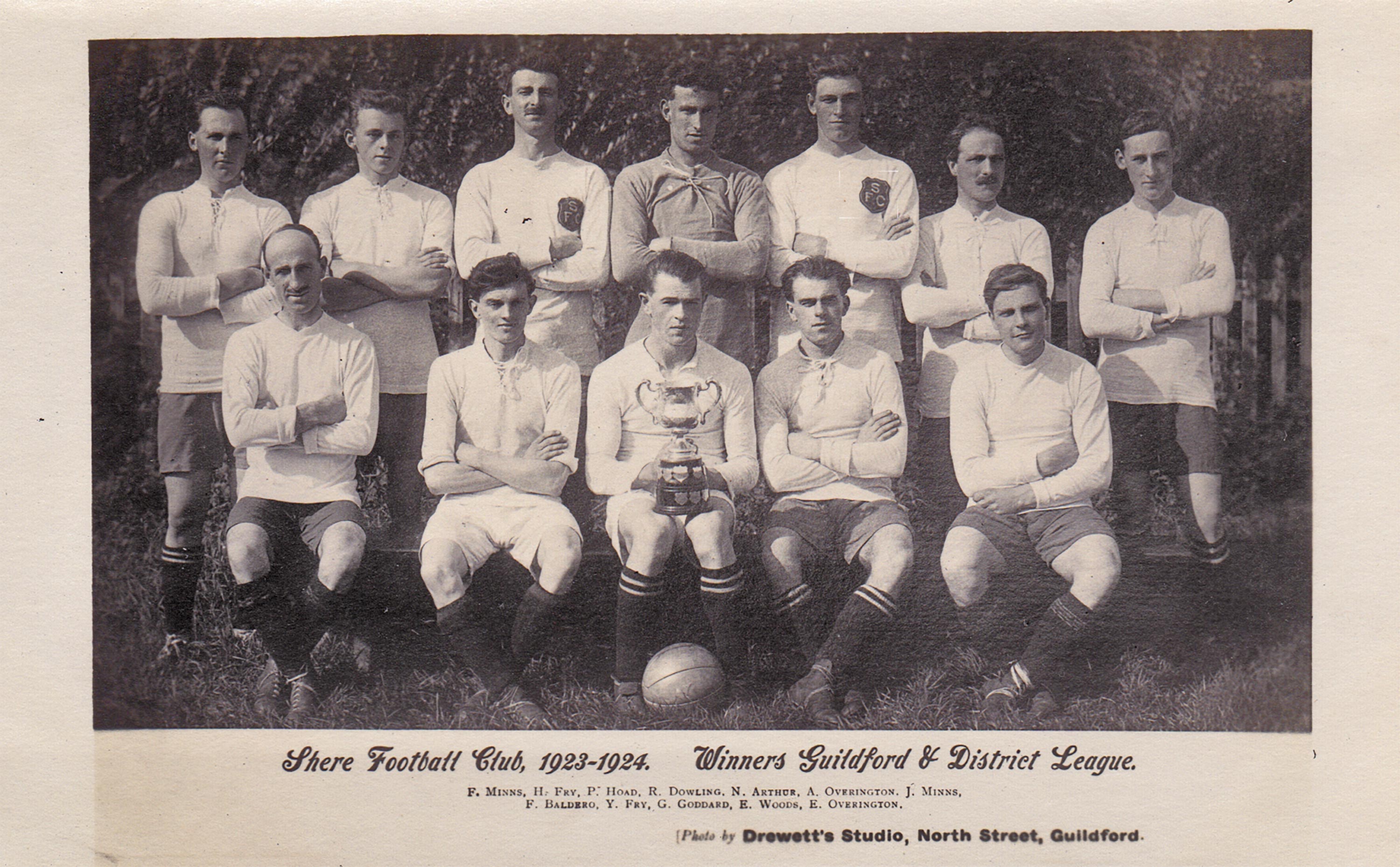
VIEW LARGER IMAGE | VIEW REAR OF PHOTO CARD
1923-1924 Winners of the Guildford & District League - Five years after World War 1, these young men played for the Shere Football Club and were District league winners:
Back row -
left to right:
F. Minns, H. Fry, P. Hoad, R. Dowling, N. Arthur, A. Overington, J. Minns
Front row - left to right:
F. Baldero, Y. Fry, G. Goddard, E. Woods, E. Overington
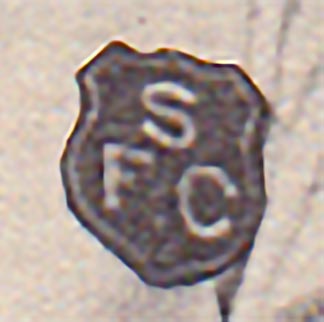 Shere Football Club logo
PREVIOUS FOITBALL RELATED ARTICLE - Sixty years on:
The Shere Tigers Football Team 1983
1926 - Agatha Christie
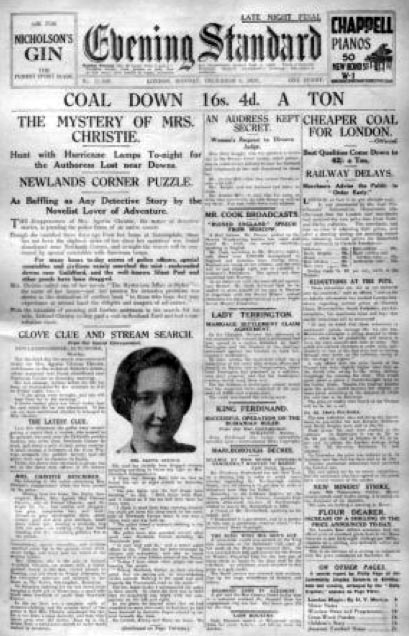
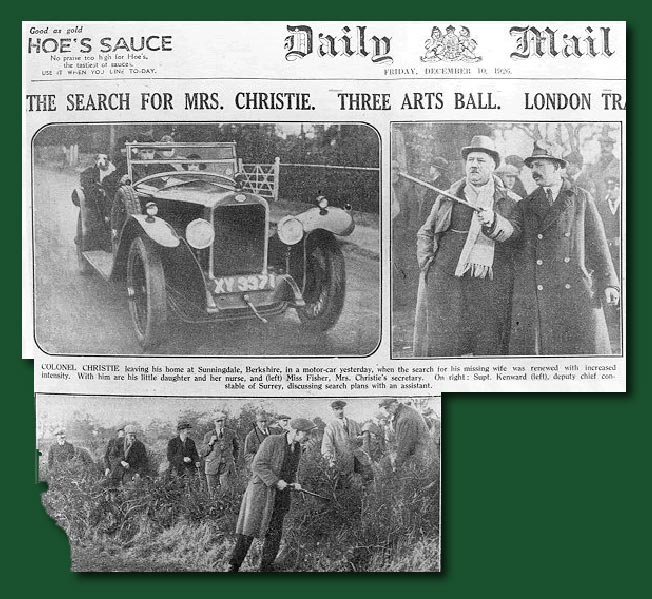
AGATHA CHRISTIE - The undisputed queen of crime, Agatha Christie has sold millions of books across the world. But in a bizarre case of life imitating art, the strangest story of all concerns the night that she faked her own death at Newlands Corner in December 1926, near Shere, and vanished into thin air...
READ MORE

UPDATE - JUNE 2021:
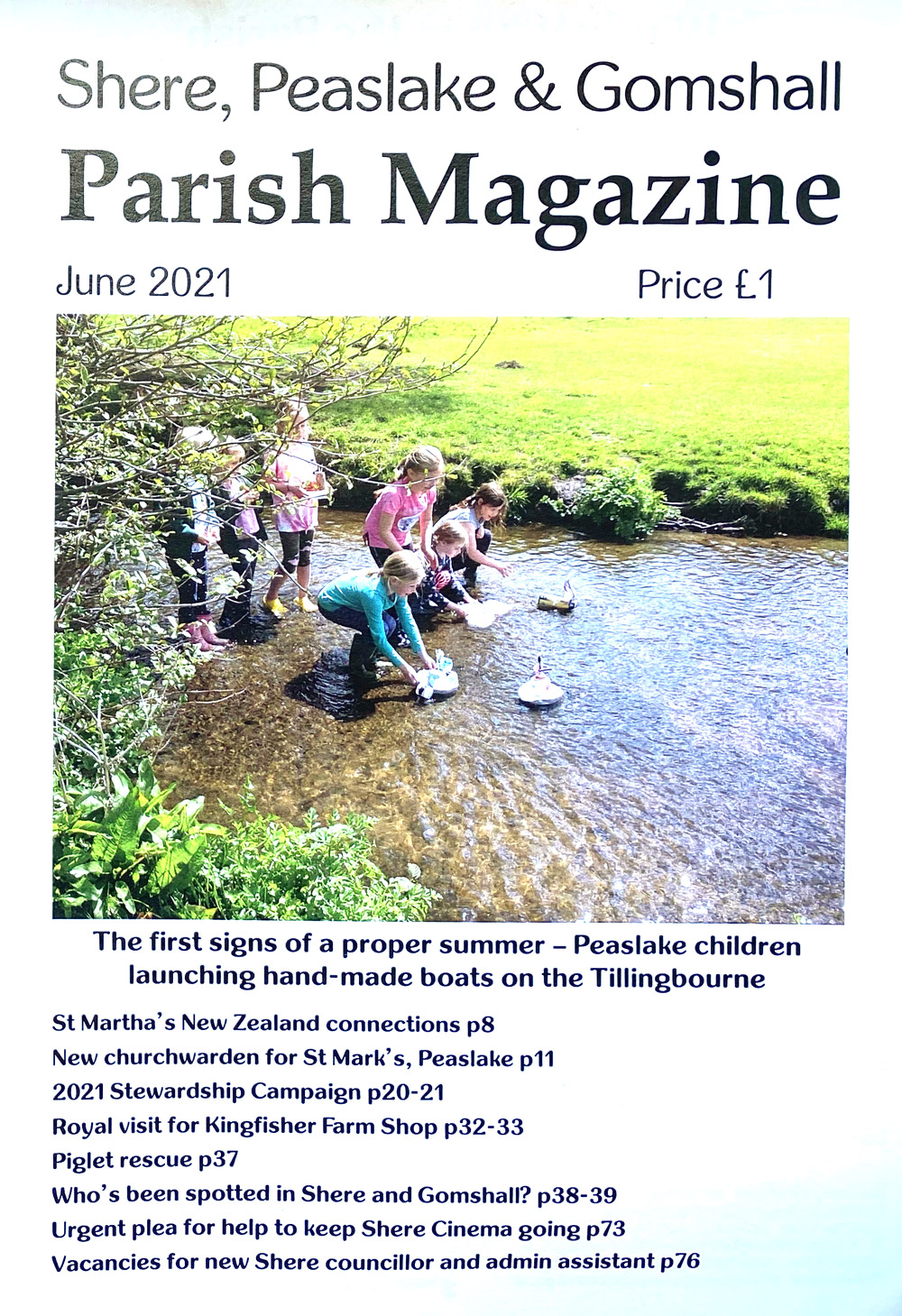
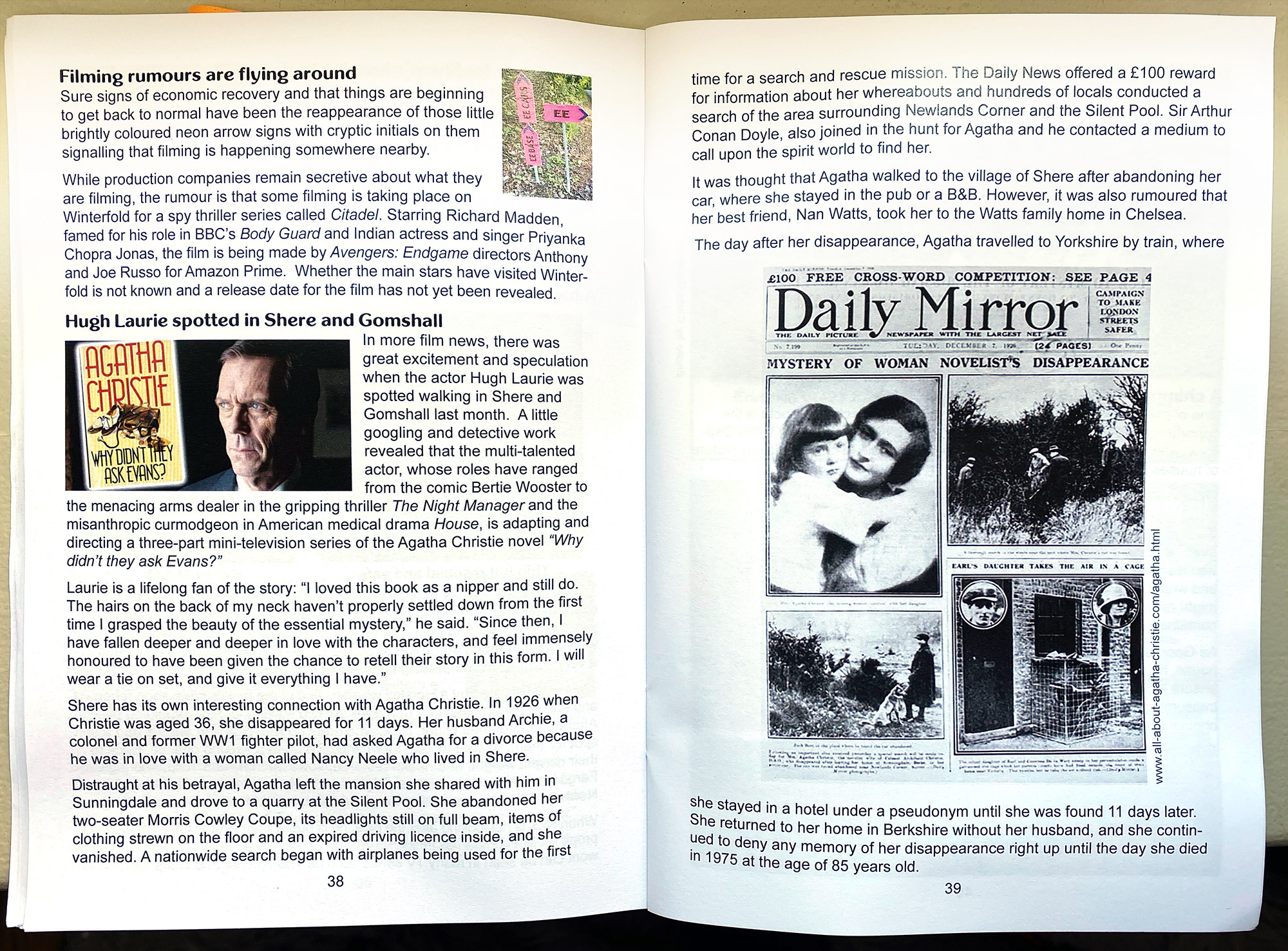
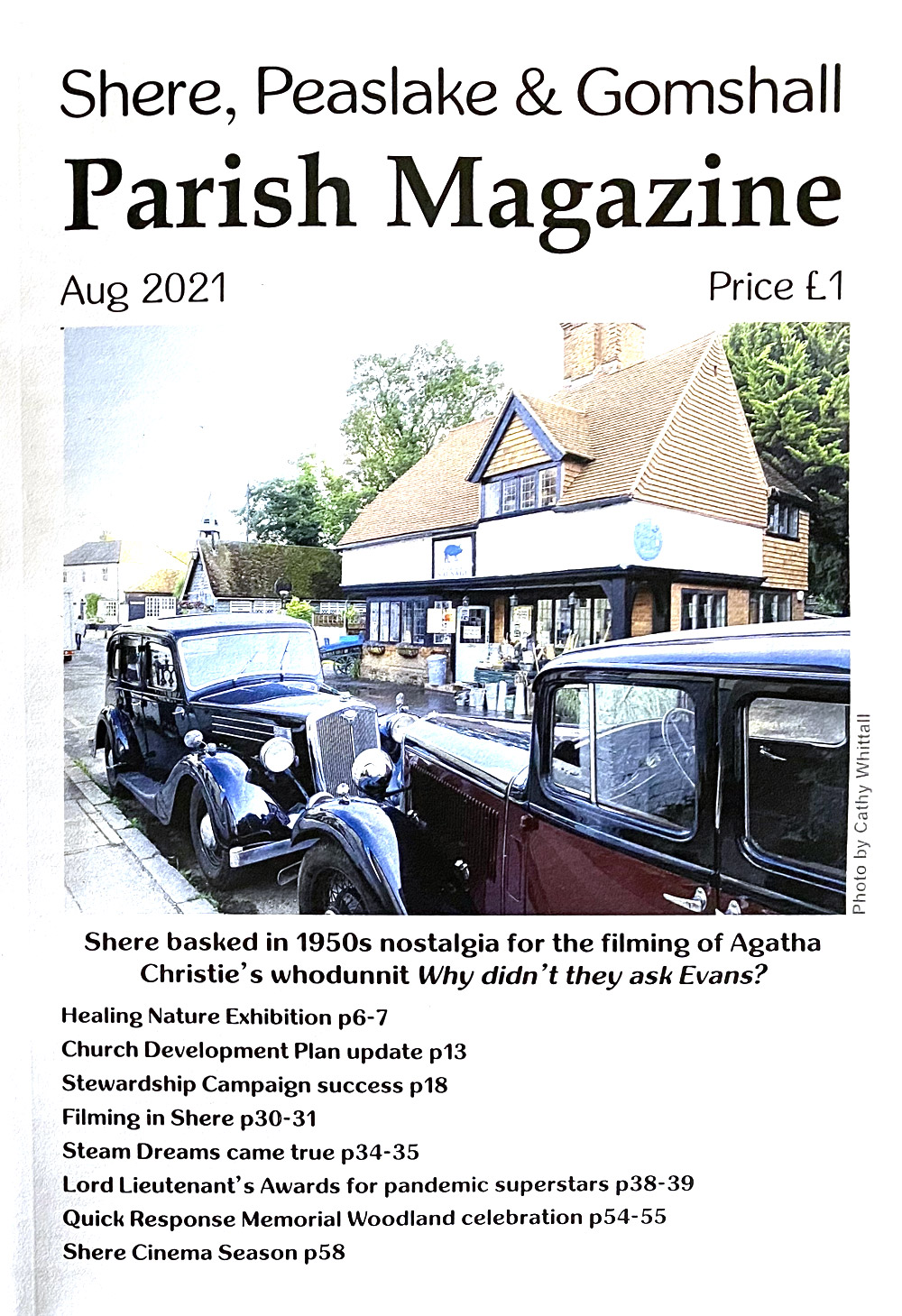
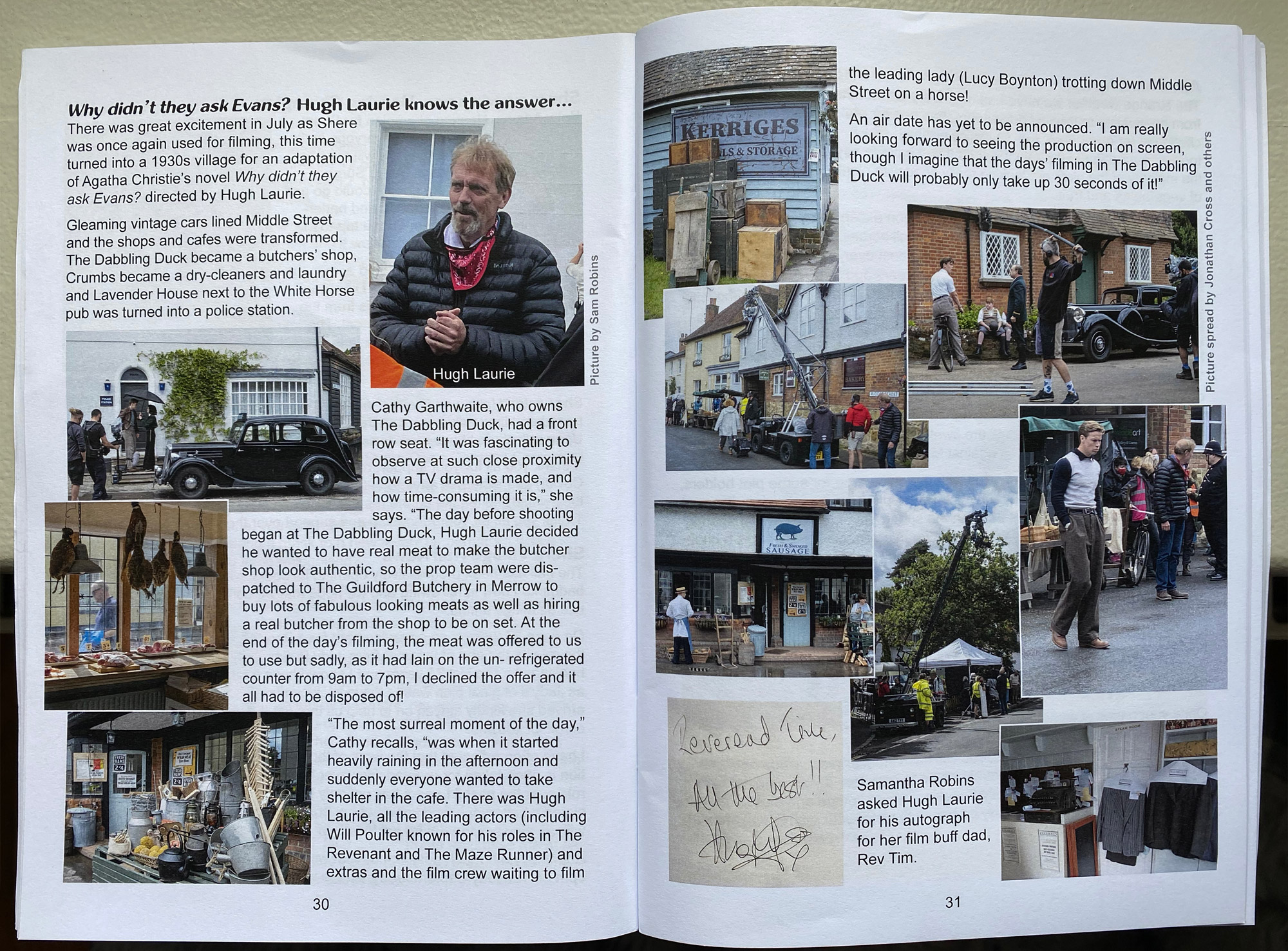
LATEST: Hugh Laurie directs the Agatha Christie's novel 'Why Didn't They Ask Evans?" - Film location in Shere - Starring Will Poulter & Lucy Boynton as reported in the June 2021 issue of the Prish Magazine:
 |
 |
|
| June Cover of the Parish Magazine | Click on the image above to read the Parish Magazine article Agatha Christie and a real life Shere murder mystery......Click HERE to read the Agatha Christie / Shere murder mystery. |
|
 |
 |
|
| August Cover of the Parish Magazine | Click on the image above to read the Parish Magazine article |
1937 - Gomshall and Shere Railway Station
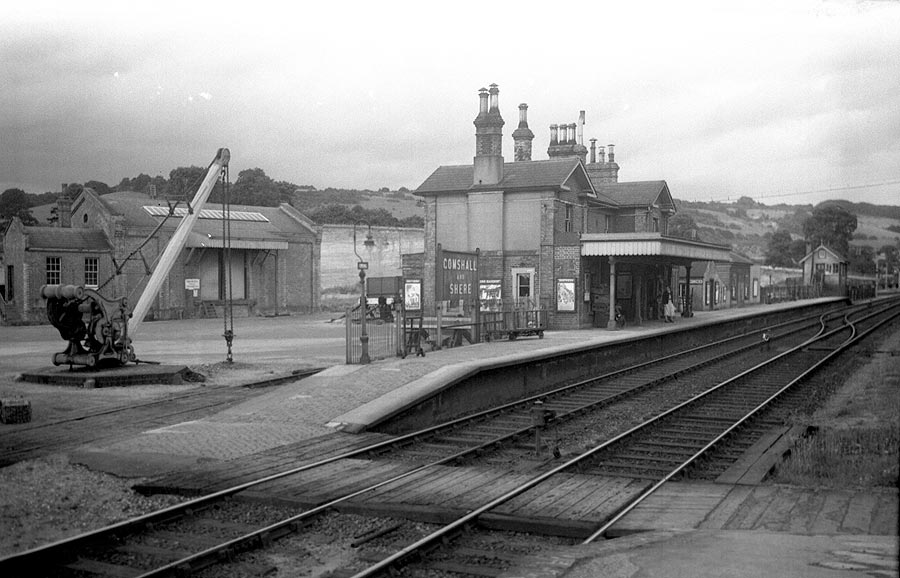
This photo was taken on 24th July 1937
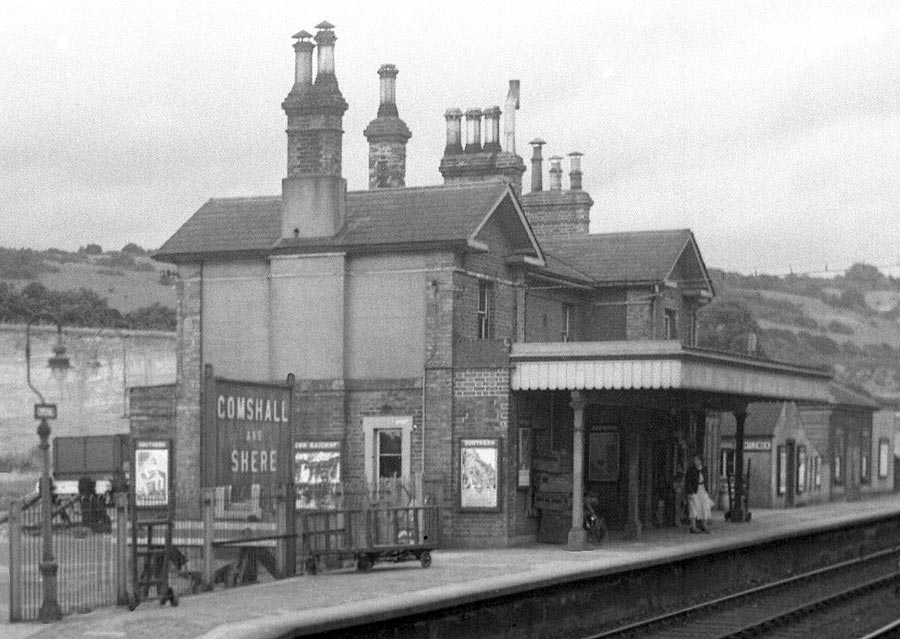
Closer shot on the Station Platform
Train crash - 1934
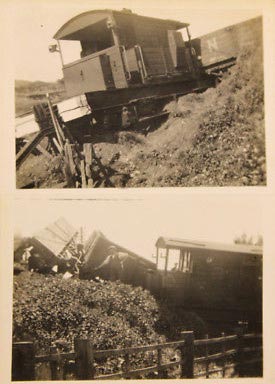
The final two uncovered photographs belonging to Miss E Frost of Crossing Gate Lodge, Gomshall, dated 1934.
I have tried to enhance the photo's:
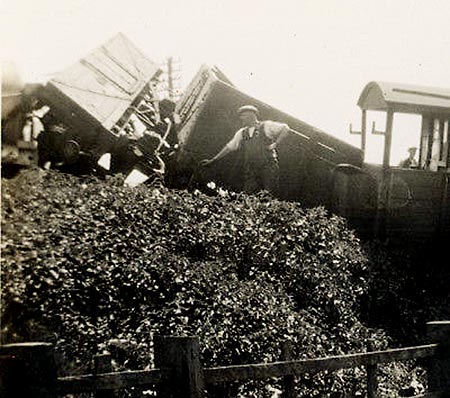
You can clearly see a man standing next to the loco.
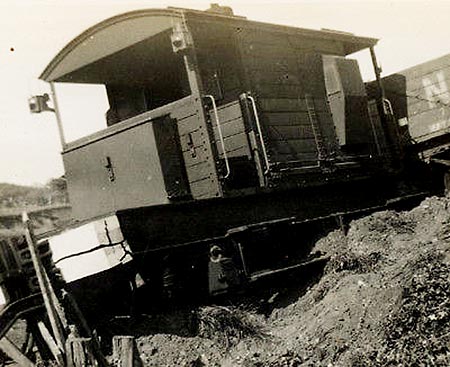
This may be a clue to the story posted bck in 2009, regarding a train crash thought to be during World War II - Full story below - Was this just a confusion with dates or totally unrelated?
1940-45

Does anyone know anything about the following story, posted HERE
"My Uncle was a fireman on the Southern Railway. I have a photograph of a smashed up locomotive. The story that has been past down to me over the years is roughly as follows: My Uncle was on the footplate of a freight train, carrying shells in a southern direction through Gomshall station. I am led to believe an express passenger train was given priority and my Uncle's train was diverted off the main line and crashed into a siding at Gomshall. I have trawled the internet and can only find a record of a crash at Gomshall in 1904. This has led to me questioning the story behind the photo I have in my possession. If anyone has any information on the authenticty of this accident I would love to hear from them, and if there is a possible line of investigation I will download a copy of the photo to aid any research" Alan T.
It would be wonderful if we could see the photo that Alan has in his possession - This was posted almost 10 years ago however (2009).
If anyone could help out on this, please contact.
1942 - Benjamin John Leader (a- 1942)
MORE DETAIL from October 1916 entry above
Benjamin Eastlake Leader's son, also named Benjamin,
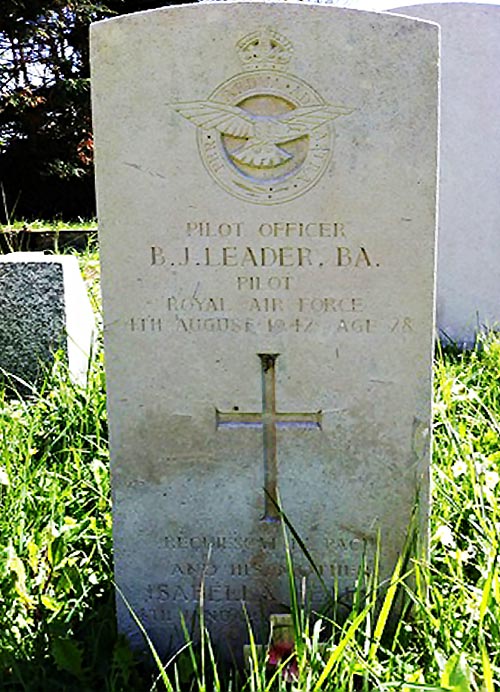 |
Benjamin John Leader's grave stone - Location of Benjamin John's grave - Bude Haven (St. Michael) Churchyard |
was 116403 Pilot Officer Benjamin John Leader, serving in the RAF (Royal Air Force Volunteer Reserve) in the Second World War until he lost his life on the 4th August 1942 aged 28.. Benjamin John was only two years old when his father, Benjamin Eastlake Leader, lost his life seving our country in the First World War.
May 17th 1943 - John Vere "Hoppy" Hopgood

Flt Lt J V Hopgood DFC and Bar
PILOT, Lancaster Bomber - 617 "Dambuster" Squadron
born: August 29th, 1921 (London, Great Britain)
died: May 17th, 1943 (Günne/Westfalen, Germany)
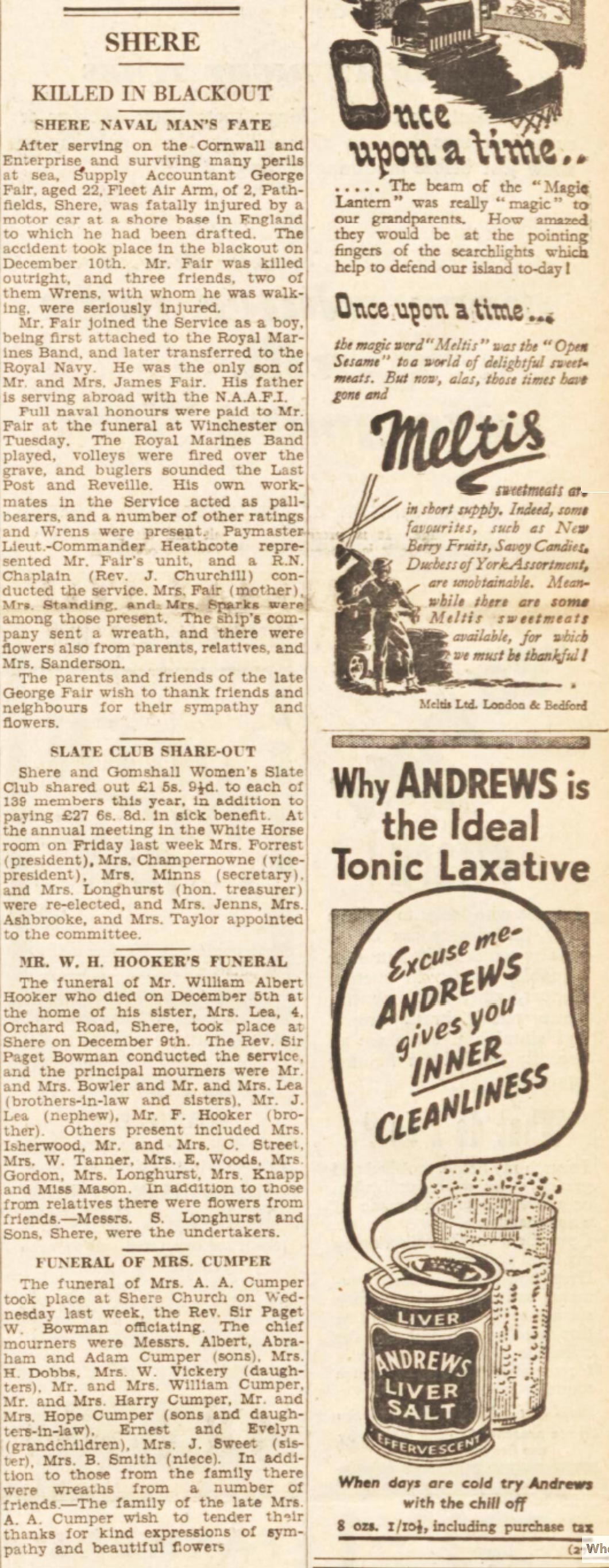
Canadian John Fraser, who survived by parachute and was taken a prisoner of war, named his daughter Shere, after the Surrey village where Hopgood grew up.
1948 - series of 4 photos
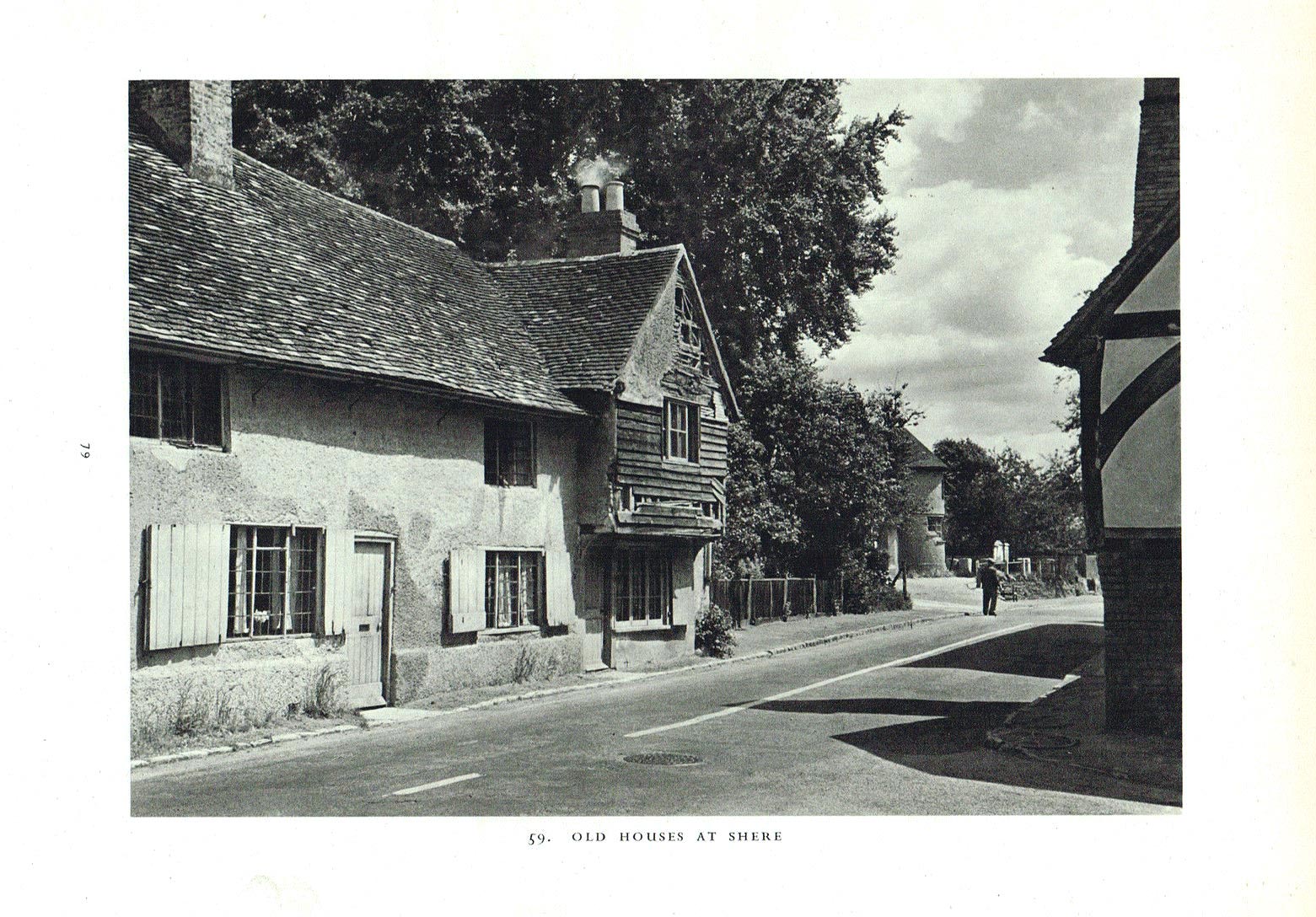
Old Houses at Shere
Looking down Gomshall Lane towards the Village Hall
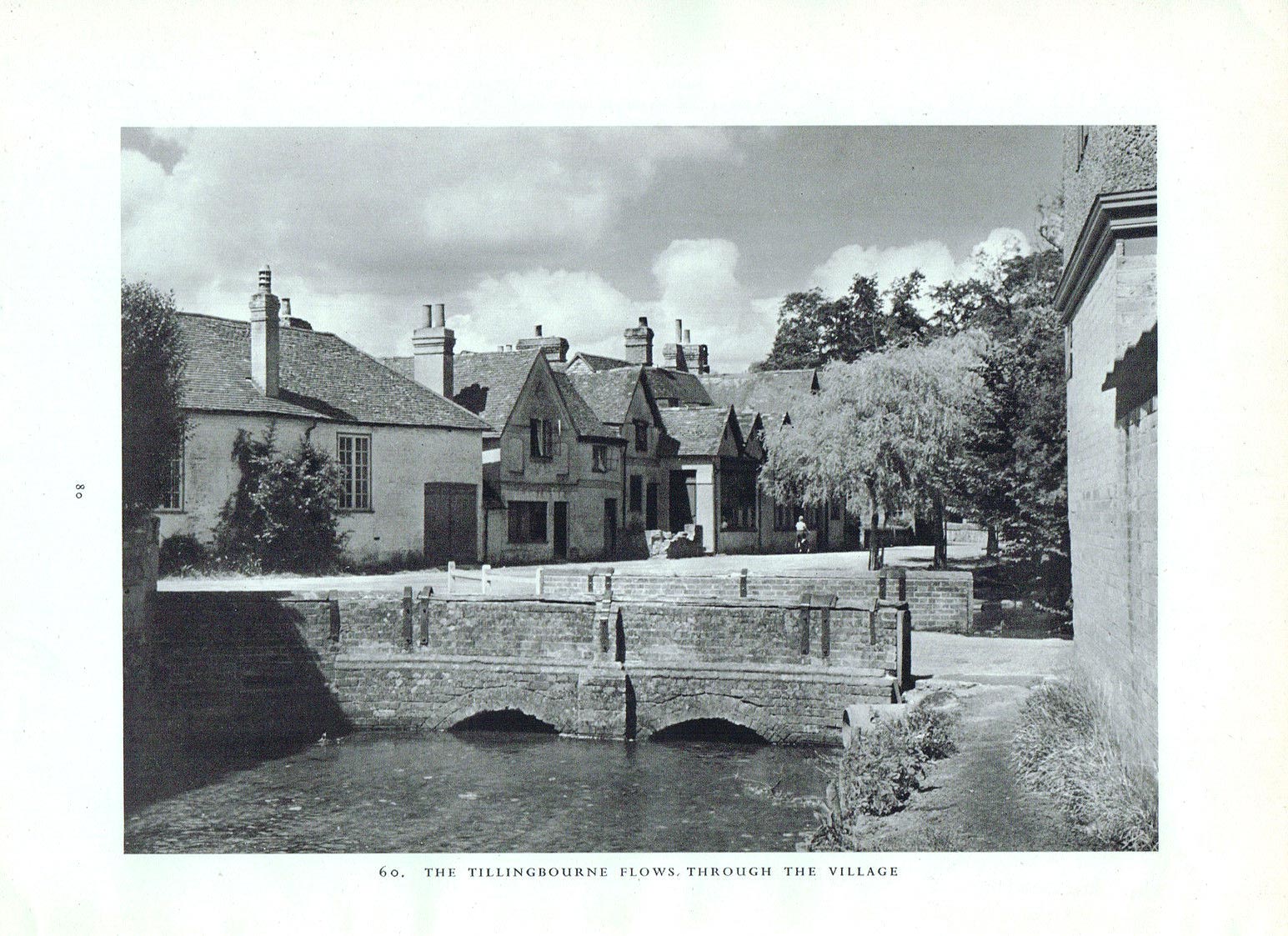
The Tillingbourne flows through the village
Looking towards the 'Lower Street'
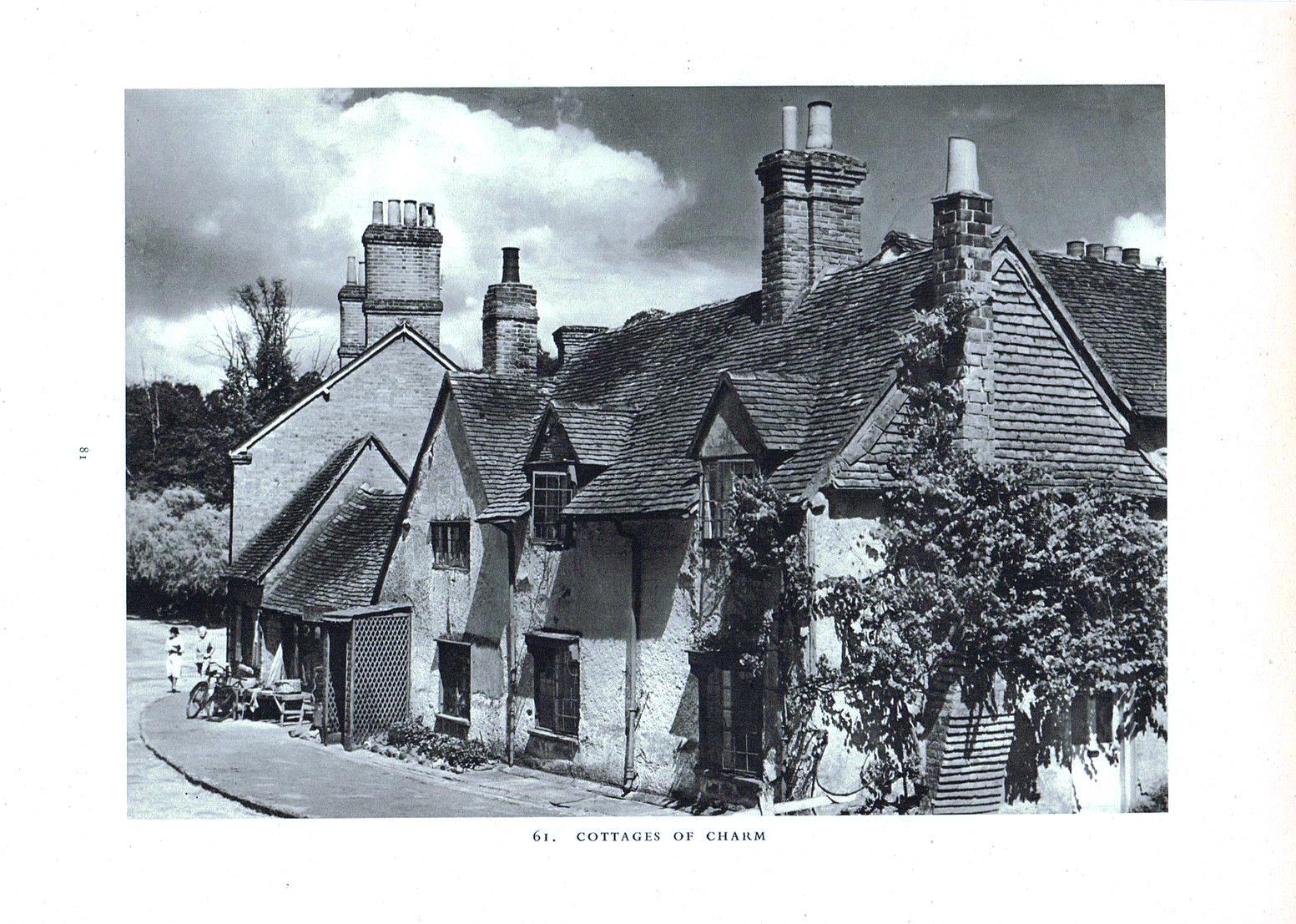
Cottages of Charm - The Square
"Grovers" (later to be Collins - see previous News item below)
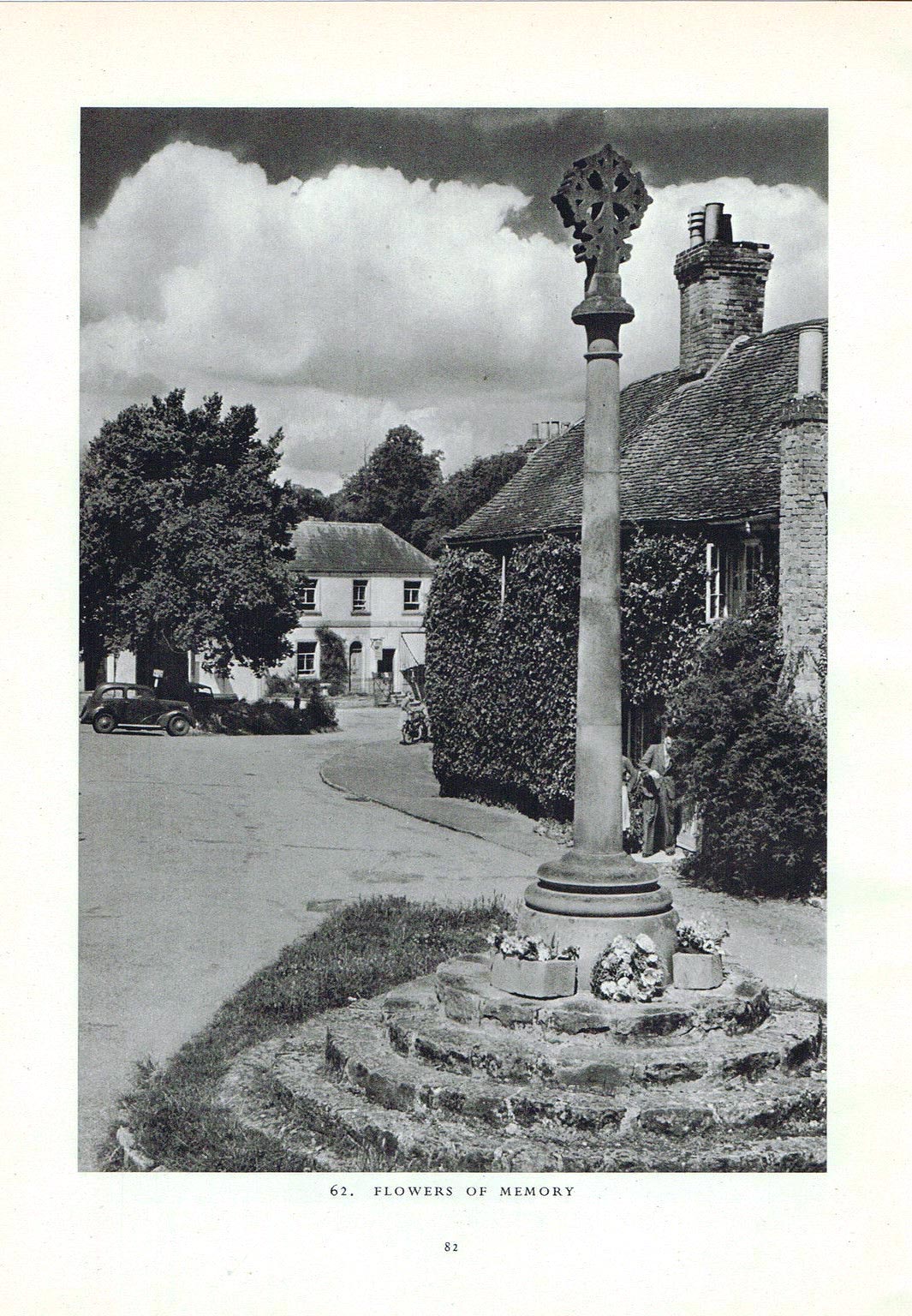
The Square
Flowers of Memory
The above four photo's have been taken from the book,
"The Surrey Hills" by W.A. Poucher (Chapman & Hall, 1949) PURCHASE
You can click on the photo's above to see a larger view
1952
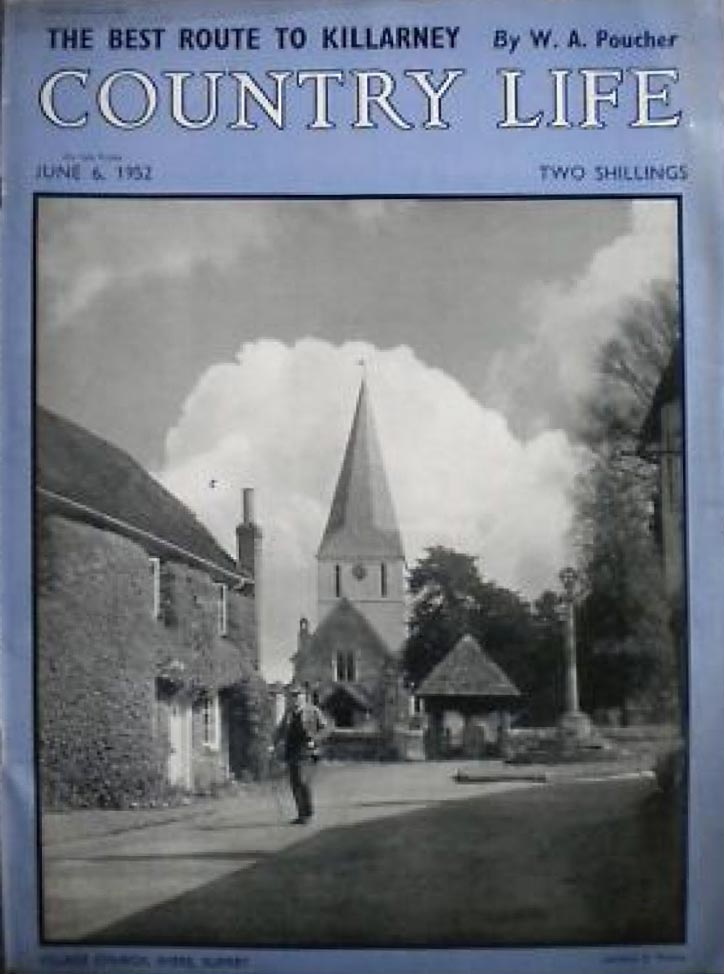
Front cover photo - St. James' Church
Locating magazine - will post any updates
1953
Here is a taste of life back in the early fiftees, as featured in the County Magazine
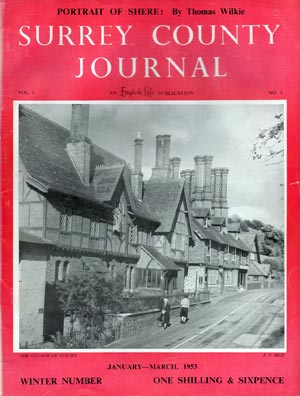
Surrey County Journal - Portrait of Shere
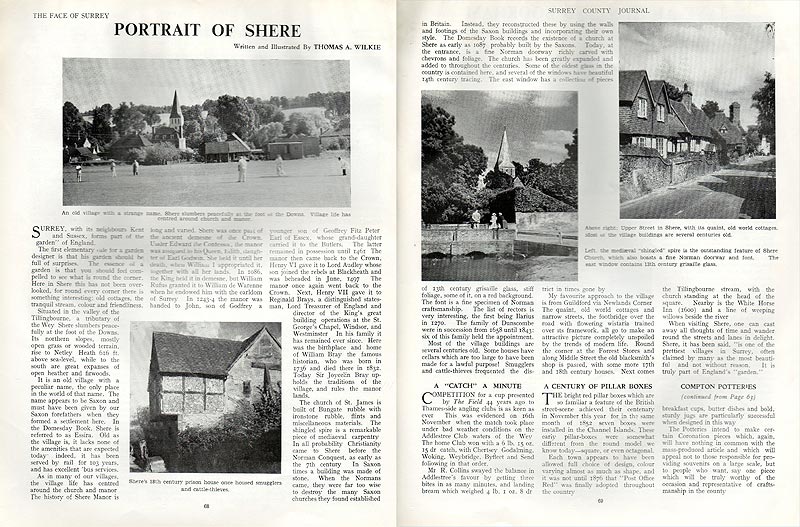
VIEW PDF of the 'Portrait of Shere' - Published January 1953
1950s
Farming in the 1950s
The Second World War had left its legacy of food rationing and a shortage of houses. It had also altered the way the Surrey Hills
were farmed. There was an ethos of utilitarianism and a continuing sense of urgency driving food production.
Frivolous niche crops like lavender, grown at Shere before the war for essential oils and dried flowers, were jettisoned in favour of food crops. The huge acreage given over to oats – the original bio- fuel powering the thousands of working horses keeping farms going
– was no longer necessary as the tractor took over.
July 1953 - Traffic Problem
12th July 1953 - BRITISH PATHE news - London in comparison to Shere

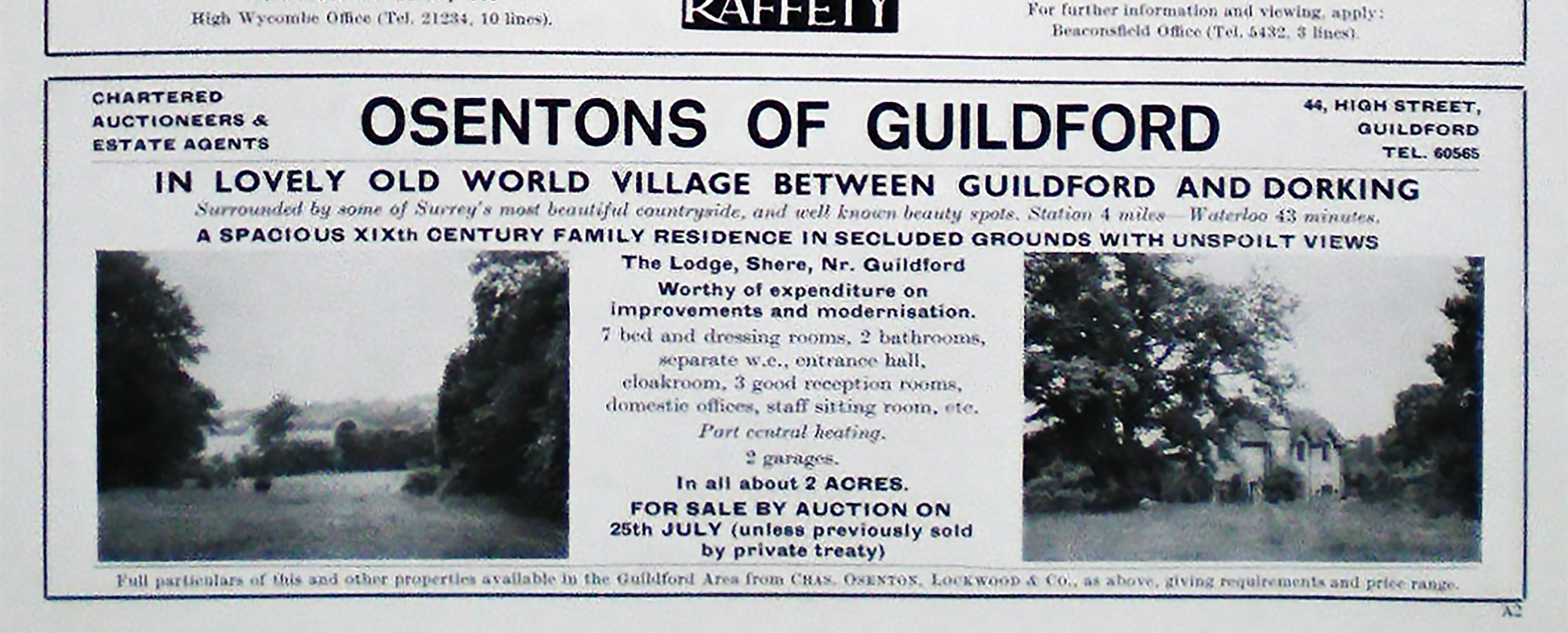
1955 - White Horse Pub
During a re-fit, a young girl's body from the Victorian era was found inthe chimney. Thought to be Emma Vincent, a maid who worked in the White Horse. Mystery surrounds her and a room has been named after her - 'Emma's Room'.
A hidden cellar containing casks of brandy, some dating back to 172, was also found. This confirmed that the White Horse was part of the smuggling activity in the area.
White Horse Inn webpage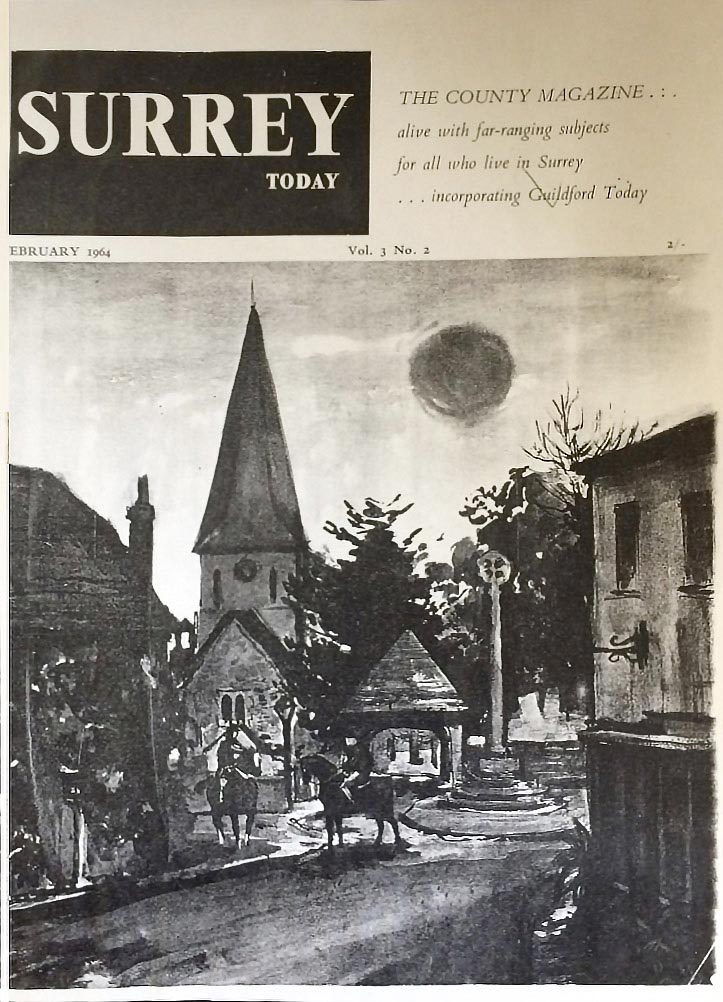
1964 - Steam Train in December
Nº7829 Ramsbury Manor approaching the staggered platforms at Gomshall and Shere on 28th December 1964
1966 - Country Life
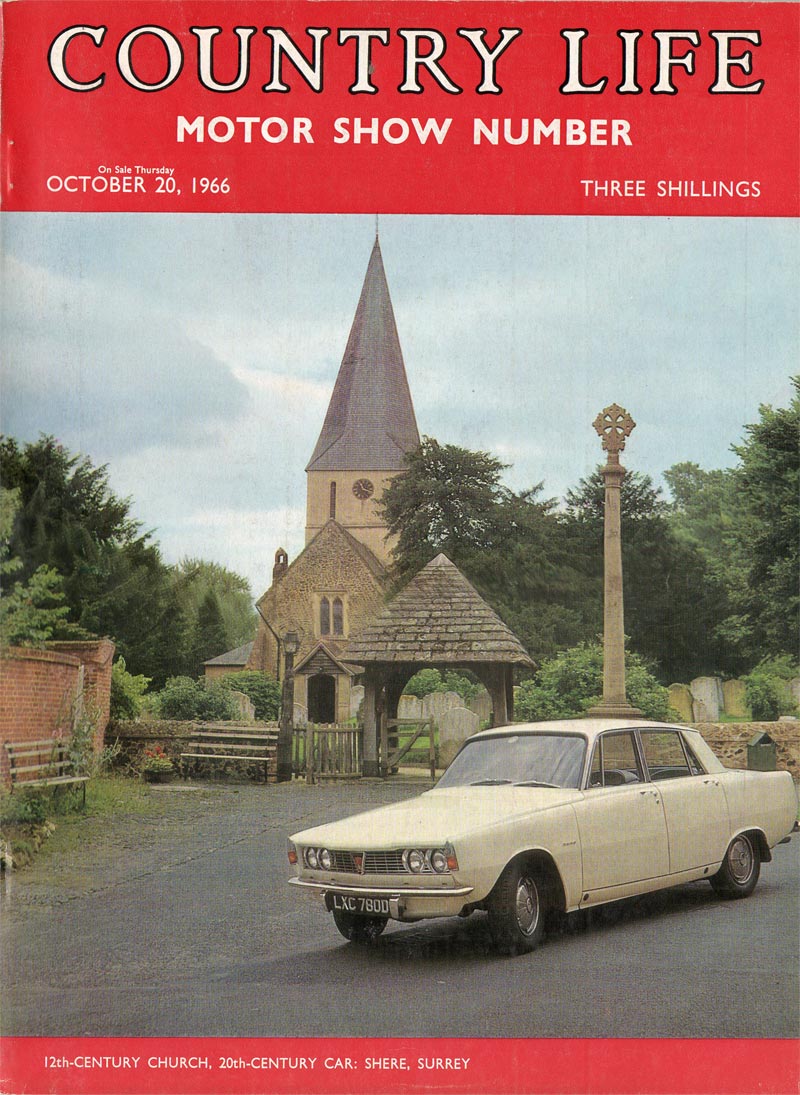
| 20th October 1966 - Motorshow Number - Cover photo titled "12th-Century Church, 20th-Century Car: Shere, Surrey" |
View - larger image
1967 - Country Life
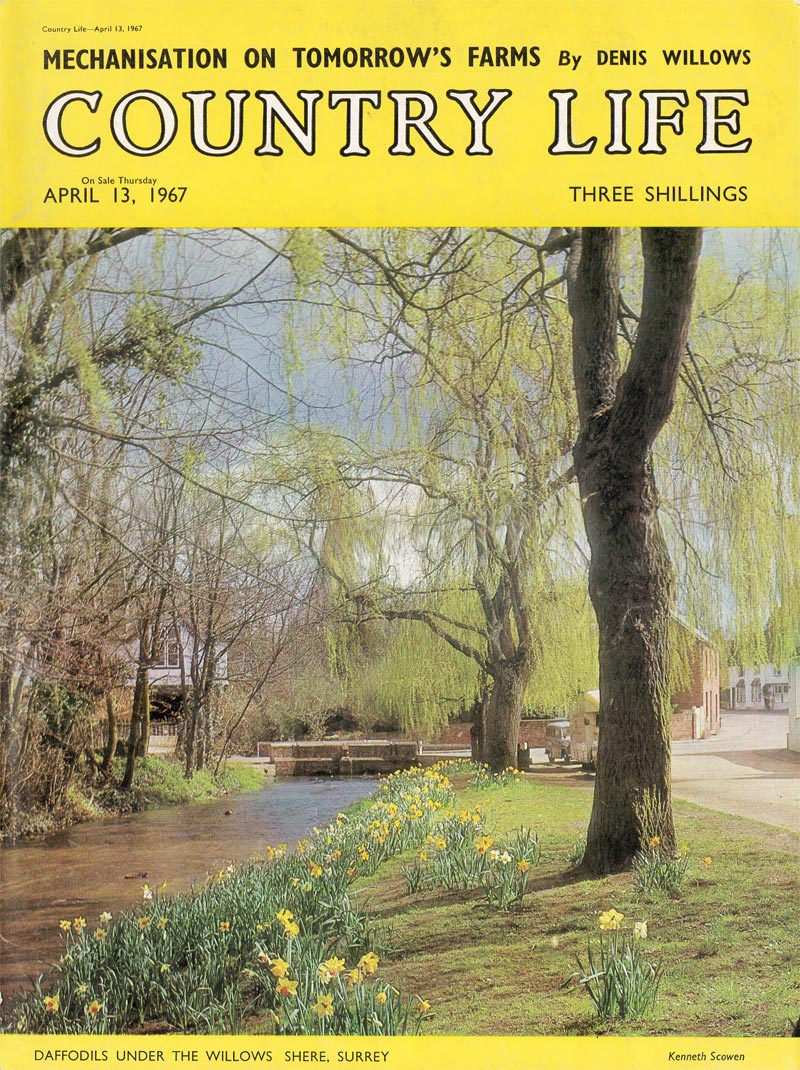
13th April 1967 - Cover photo titled
"Daffodils Under the Willows: Shere, Surrey"
View - larger image
1984 - Pram Race
The website "For Those who policed Surrey" has some amazing stories by the Police in Surrey and makes for some
really interesting reading as well as building a great picture of the past events and life experiences.
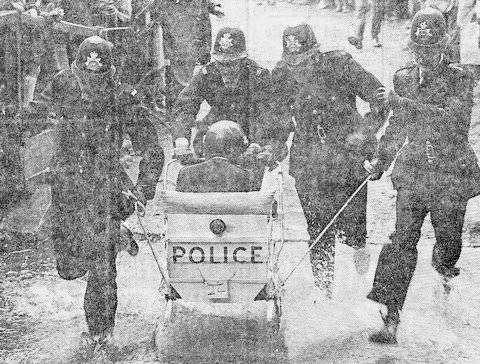
In the old days Shere staged an annual Pram Race to raise funds for good causes. It hasn’t been held now for many years.
However, we did manage to get Geoff Breckles permission to enter one year. At that time we had an office cleaner called Jenny Renshaw who sadly died at a very early age from a heart attack. She assisted in the procurement of a pram and the rest of the officers at Shere created what you see before you with Police signs etc. The team were myself, then Pc 43 together with ex Pc 625 Merv Young the Gomshall Pc, Micky Finch who was at Shalford and a guest appearance from
Mark Hampshire then at Guildford. Jenny is in the pram. The picture was shot as we went through the River Tillingbourne at Shere at the start of the race and appeared in the Surrey Advertiser. - Jon Smith
1984 - Shere Museum
Shere Museum opened in the Old Malt House as a one-day event in 1984, part of Shere’s annual “Fair in the Square”. The core of the exhibition came from an accumulation of domestic and agricultural items left by the previous owners. In 2009, after 25 years as a collection in a private house, the museum was moved to new premises converted from the former Working Men’s Club.
Shere Museum is now housed in the original Shere Parish Hall in Surrey, which was built to commemorate Queen Victoria’s Diamond Jubilee in 1898. When the men of Shere returned from serving in the First World War the parish wished to honour them, by completing the present Village Hall in 1922, the Parish Hall became available for The Shere Working Men’s Club. The Shere Working Men’s Club closed in 1997 and the hall lay empty until 2006 when a team of volunteers started work on converting the building to house the museum collection.
1988

1988 Shere Pottage
Stapled booklet with 44 pages. Illustrated with b/w photos of local scenes & characters. Collection of Local history with recipes.
1994
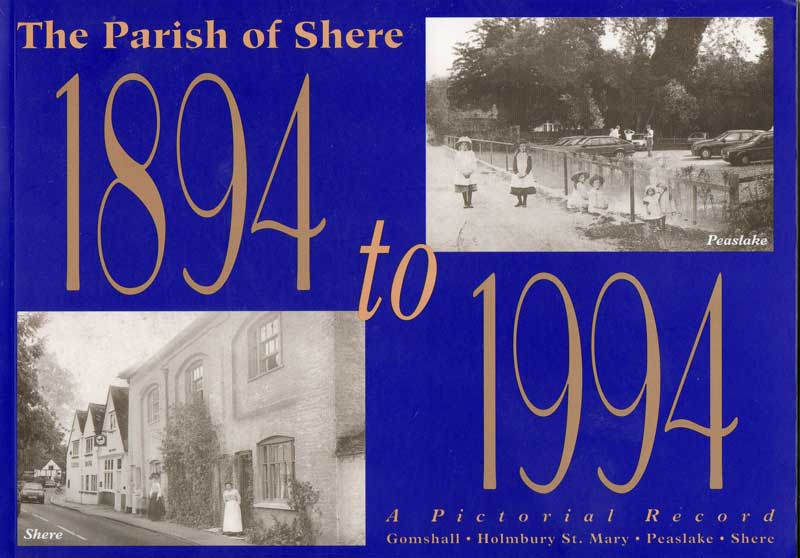
1894 to 1994 - A Pictorial Record
This book was pblished to celebrate the centenary of the formation of Parish Council's in general and Shere Parish Council in particular.
The major part of the book comprises old photographs of local scenes together with their modern equivalents
Can be purchased from the Shere Museum - Highly recommended as its packed with over 80 pages.
2000
St James' Churchyard
Given to the village by the Bray Family, Lords of the Manor of Shere Roll over the image to take a closer look John Wesley's Rule 1703 - 1791 |
2003
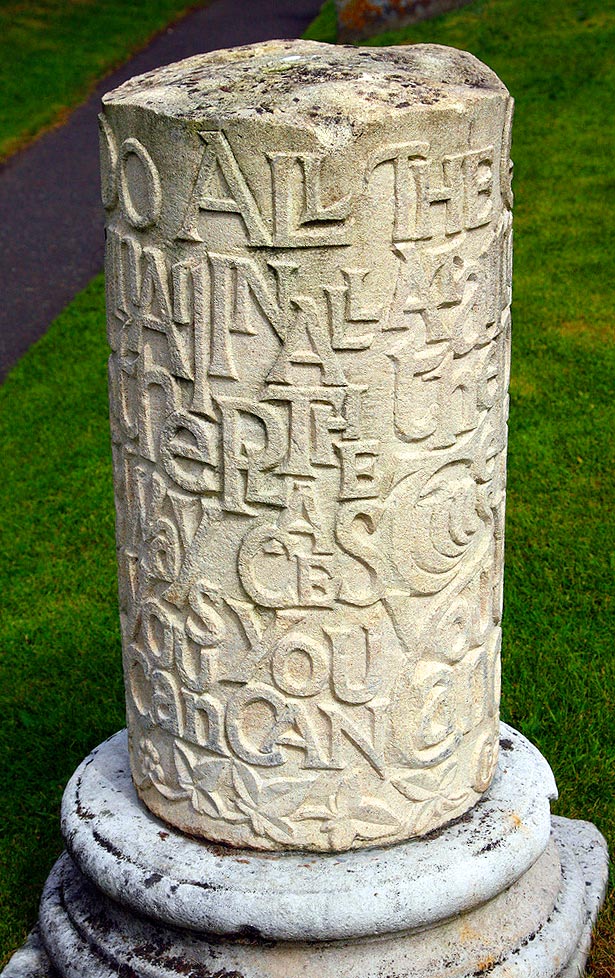
A great source, reference and enjoyable read, these suite of three Historical books
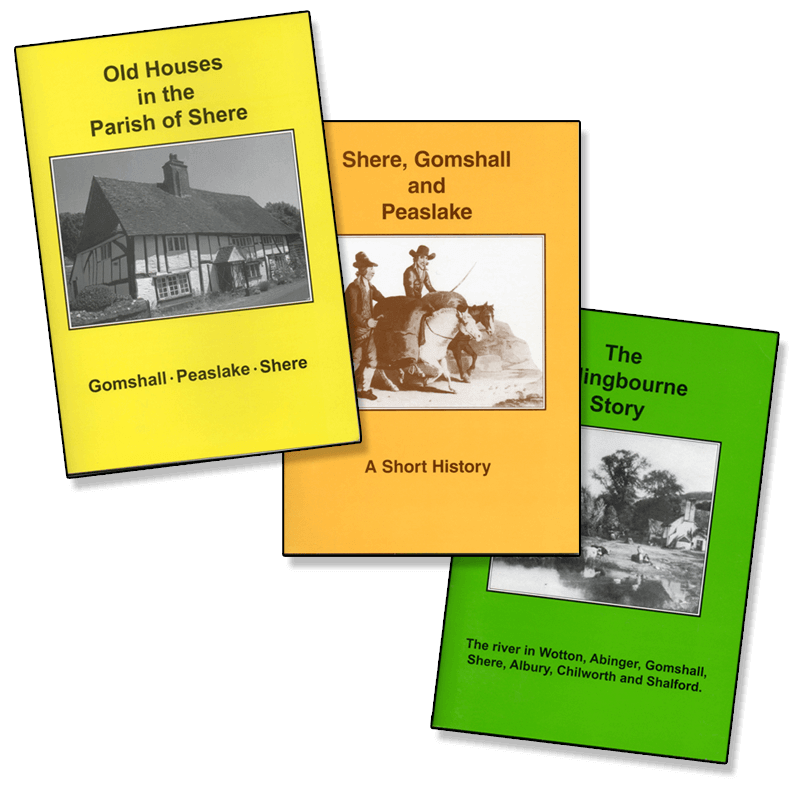
Can be purchased from various locations in and around the villages - All revised and reprinted in 2003
Old Houses in the Parish of Shere
First published 1976
Reprinted 1977
Revised and Reprinted 1981
Reprinted 1985, 1992, 1993
Revised and Reprinted 1995
Reprinted 1997
Revised and Reprinted 2003
Reprinted 2005, 2008
Shere, Gomshall and Peaslake - A Short History
First published 1981
Reprinted 1984, 1988, 1989, 1993
Revised and Reprinted 1997
Major revision 2003
Reprinted 2005, 2008
The Tillingbourne Story
First published 1984
Revised and Reprinted 1998
Revised and Reprinted 2003
Reprinted 2006
Reprinted 2010
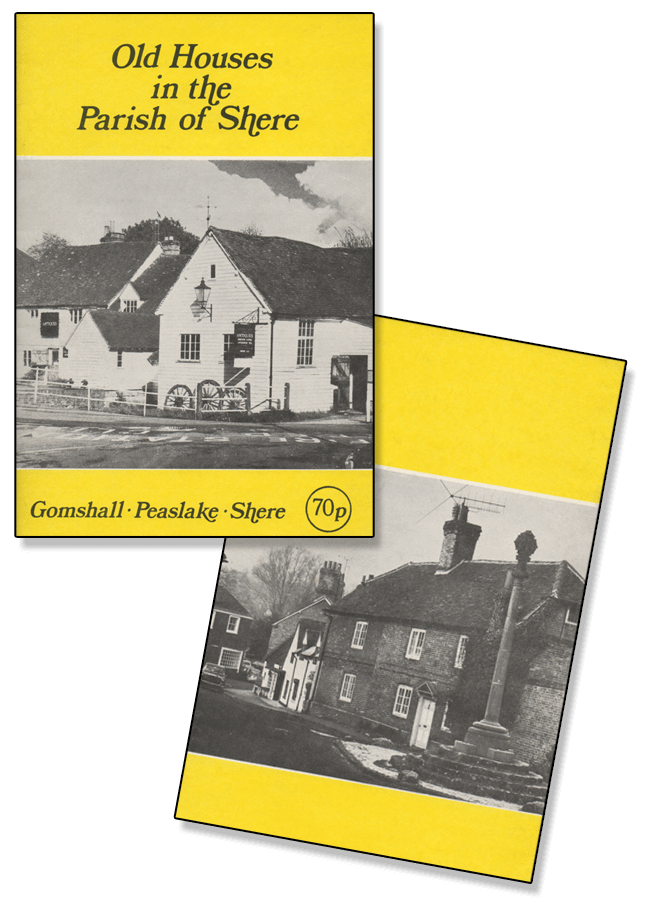
First published version (reprinted 1985 version)
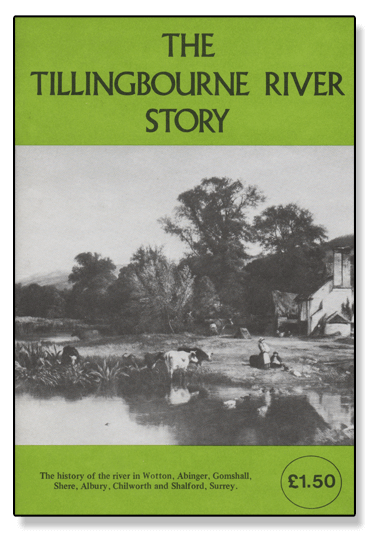
First published version (1984)
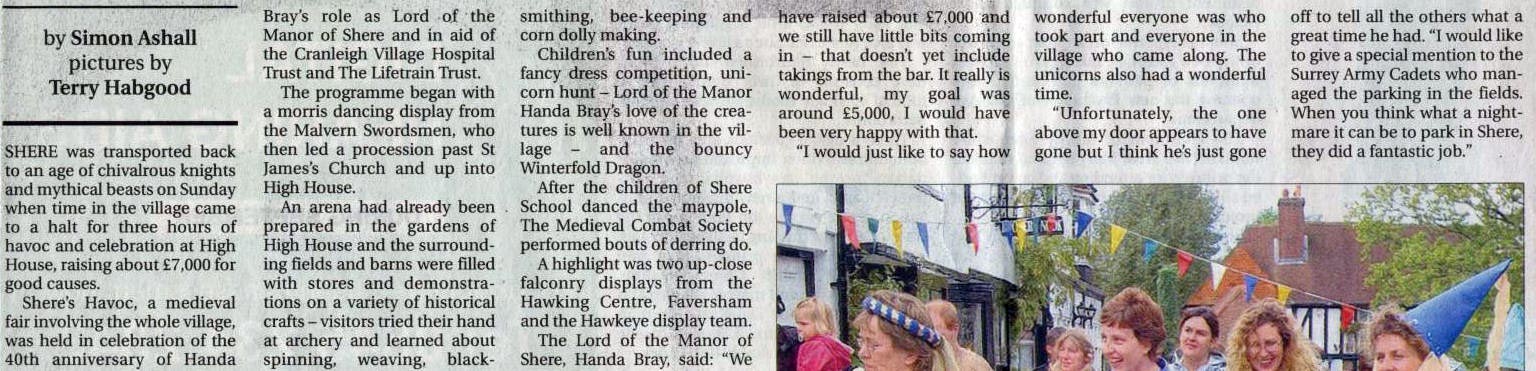
2007 - August
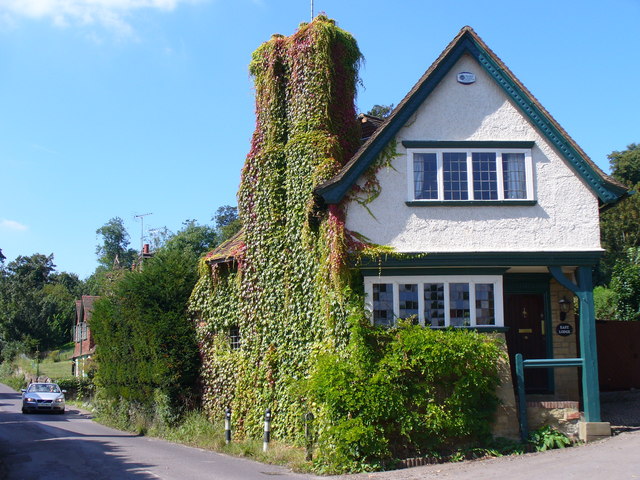
East Lodge covered in Ivy
photo © Copyright Colin Smith and licensed for reuse under this Creative Commons Licence.
2008 - 12th January
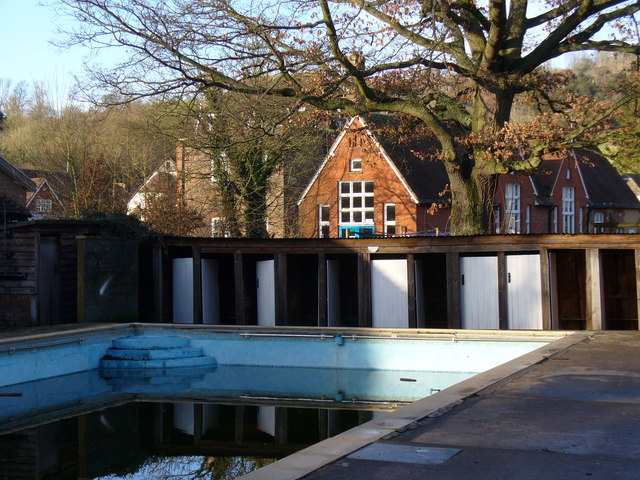
Shere Swimming Pool
photo © Copyright Colin Smith and licensed for reuse under this Creative Commons Licence.
2009 - December
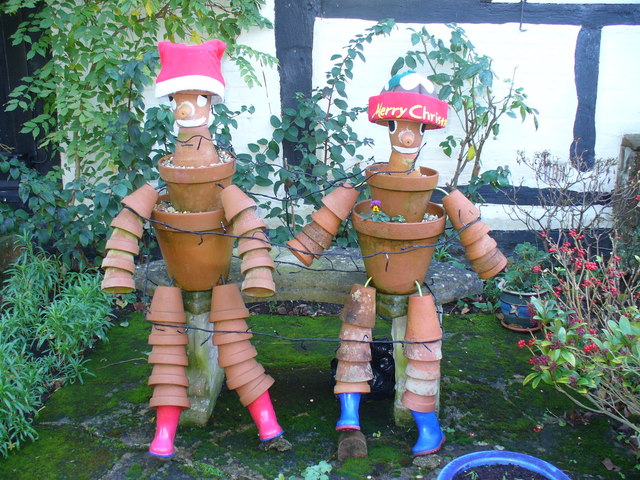
Bill and Ben - creation of Ron Chapman
photo © Copyright Colin Smith and licensed for reuse under this Creative Commons Licence.
Many thanks to Colin Smith for so many wonderful photo's, recording life around Shere Village. All rights reserved, © Colin Smith
2009 Shere Museum
A great and fun place to start finding out more about the village history is by visiting the 'Shere Museum'.
"The extensive displays include objects of daily life - tools, toys, domestic items, wartime and leisure - mainly from Victorian times to the 1950s and some surprising finds from earlier periods. The collection covers all aspects of the history of the parish of Shere, which encompasses the villages of Shere, Gomshall, Peaslake, Holmbury St Mary and parts of Abinger. Visitors can browse the collection in a friendly and informal atmosphere; children are particularly welcome, volunteers are always on hand to answer any questions you may have" - Shere Museum
Shere Museum is now housed in the original Shere Parish Hall in Surrey, which was built to commemorate Queen Victoria's Diamond Jubilee in 1898 - see 1985 entry above
Shere Museum
Gomshall Lane
Shere
Surrey
GU5 9HE
Tel: 01483 202769 | WEBSITE

The first Reffell brewery was at nearby Gomshall, and was located behind the Black Horse and originates from 1817.
The currently closed Shere Museum is located in an old Malt House that dates from about 1830 and was used in the preparation of
the ingredients for the beer that was brewed at Gomshall.
There are currently two public houses in Shere; the White Horse and the William Bray (previously the Prince of Wales and before
that Cook's Beer House), both of which were at one time supplied with beer from the Gomshall Brewery.
MORE AT THE REFFELL FAMILY HISTORY WEBSITE
Other links / contacts
Local History Society
Listed Buildings in Shere

Exploring Surrey's Past

exploring surrey's past - Shere
British History On-line

Shere | British History online
Special Thanks...
...to Shere Museum for access and permission to publish some of the older photographs from their archives - Please visit and support the Village Museum on Gomshall Lane, Shere.